

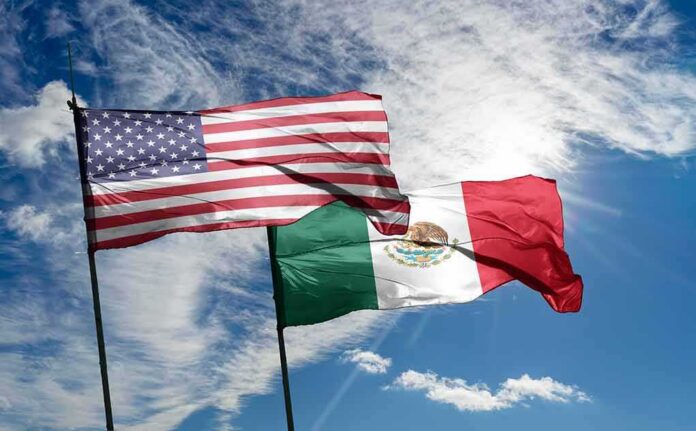
As Mexican ruling-party officials quietly offer secrets to U.S. agents, the line between fighting cartels and foreign meddling is getting dangerously thin for both countries.
Story Snapshot
- Ruling-party Mexican officials are secretly sharing information with U.S. authorities, often to shield themselves from cartel investigations.
- President Trump’s administration is pushing hard for arrests and extraditions of Mexican politicians tied to drug cartels, raising sovereignty fears in Mexico.
- The Federal Bureau of Investigation (FBI) and other U.S. agencies are cultivating Mexican insiders as informants when formal cooperation moves too slowly.
- This informal intelligence network exposes deep corruption but also feeds public anger that “deep state” deals happen far from democratic oversight.
Mexican Officials Turn Informant Amid U.S. Pressure
Reports from major outlets say more than a dozen Mexican officials from the ruling Morena party have quietly approached U.S. authorities with offers to share intelligence on fellow politicians. Many of these insiders are governors or members of Congress who fear they may be targets of U.S. drug and corruption probes. They hope that by giving information on others, they can win lighter treatment for themselves. That creates a strange mix of self-preservation and anti-corruption zeal.
President Trump’s administration has sharply increased pressure on Mexico over what U.S. officials call “narcopolitics,” the web of ties between politicians and cartels. U.S. leaders have demanded that President Claudia Sheinbaum’s government investigate and extradite sitting officials linked to drug groups, even threatening tariffs if Mexico does not act. Recent U.S. indictments have charged ten current and former officials, including the governor of Sinaloa, with trafficking and weapons crimes. That legal push gives Mexican informants strong reason to cut deals.
Informants, Extraditions, and Quiet Deals With U.S. Agents
A striking case involves the governor of Baja California, who was recorded offering to become an informant for the Federal Bureau of Investigation in order to avoid extradition. In that conversation, she suggested sharing information from state security meetings, hinting that what she hears there could help U.S. investigators. She later claimed publicly she only wanted her canceled U.S. visa restored, but American officials say many extradited Mexican figures are now cooperating to reduce possible life sentences.
Analysts note that dozens of newly extradited Mexican drug traffickers and officials are believed to have become cooperating witnesses for U.S. prosecutors. Facing long prison terms, they trade insider detail on cartel routes, corrupt politicians, and dirty police units for better plea deals. This pattern is not new. Earlier cases showed Mexican commanders feeding Drug Enforcement Administration (DEA) investigations to cartels for cash, proving how easily intelligence channels can be twisted. Today, U.S. agencies seek “tangible results” by cultivating informants when formal channels bog down.
Security Cooperation, Sovereignty Fears, and Deep State Worries
For years, Mexico and the United States have signed security pacts that promise joint action against cartels, weapons smuggling, and illegal crossings. These deals talk about mutual respect, shared goals, and safer communities on both sides of the border. At the same time, U.S. records show a long history of deep intelligence ties, from the Mérida Initiative to joint Northern Border Response Force operations that embedded U.S. personnel and information inside Mexican efforts. The current wave of informants sits inside this larger pattern of cross-border security work.
Mexican leaders, however, often see these moves as direct interference in their politics. President Sheinbaum has accused the United States of meddling after probes and public charges against her allies, arguing Mexican courts have seen no evidence. A previous Mexican law sharply limited foreign law enforcement agents, forcing all contacts through the federal government and cutting back open cooperation with U.S. counterparts. Critics said that law was pushed by powerful military interests to stop deeper investigations into their own ranks. Ordinary citizens on both sides look at this tug-of-war and see elites protecting themselves.
What This Means for Ordinary Americans and Mexicans
This informant system may help expose cartel-backed officials who fuel violence, drug flows, and corruption that hurt families from Tijuana to Texas. Yet it also strengthens the sense that key decisions are made in private deals between prosecutors, politicians, and shadowy insiders, not in open courts or elected bodies. Many Americans already feel the federal government is run by an unaccountable “deep state.” When they hear about foreign governors cutting quiet bargains with agencies like the Federal Bureau of Investigation to save themselves, it reinforces those fears.
For Mexicans, learning that ruling-party officials are secretly informing on one another to a foreign power feeds a different worry: that sovereignty has been hollowed out by corruption and outside pressure. For both nations, the stakes are high. Real cartel networks must be broken, but if the fight relies mostly on secret informants, sealed indictments, and political bargaining, trust in democracy erodes further. The story unfolding now in Mexico’s government is not only about drugs and crime; it is also a test of whether rule of law can survive elite self-interest and cross-border power games.
Sources:
theatlantic.com, nytimes.com, youtube.com, infobae.com, facebook.com, politico.com, nsarchive.gwu.edu, latimes.com, brookings.edu, lawfaremedia.org, cbsnews.com, leidensecurityandglobalaffairs.nl, mexiconewsdaily.com, csis.org, state.gov
© unitedfrontnews.com 2026. All rights reserved.