
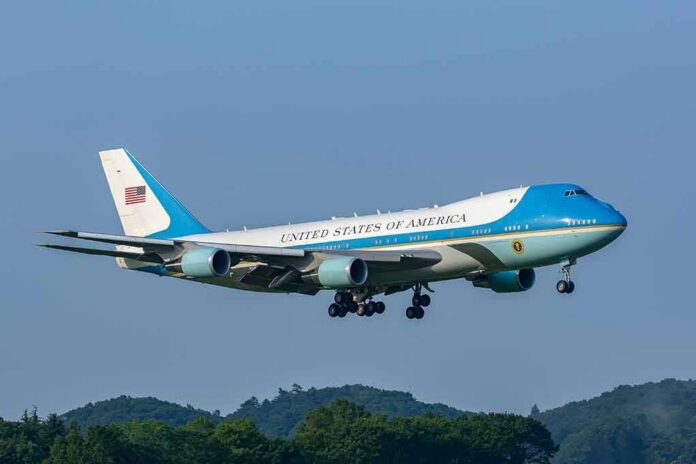
A deployed emergency slide on the presidential jet briefly delayed President Trump’s Dallas trip, but crews cleared it and the flight departed safely.
Story Snapshot
- Air crews inspected a deployed slide on the new presidential aircraft before takeoff.
- President Trump said the check would take about 15 minutes and affirmed the plane was safe.
- Reporters saw the slide on the right-front door, opposite the usual boarding door.
- FAA guidance says slide deployment can be part of functional testing.
What Happened on the Tarmac at Joint Base Andrews
On the tarmac at Joint Base Andrews, reporters saw an emergency slide deployed from the right-front door of the presidential aircraft before boarding. United States Air Force personnel examined the slide and surrounding door area while cameras rolled. President Trump told reporters the crews were “checking it” and said the process would take about 15 minutes. He then boarded and the plane departed for Dallas, with the minor delay noted by the press pool.
Press accounts described the slide on the opposite side from the door President Trump typically uses. That detail matched images of the right-front door, while the President boards from the left-hand side. On-scene reporting framed the action as a safety check, not an evacuation. The moment drew attention because a deployed slide is a dramatic sight, even when it is part of a routine verification before flight.
What Officials and President Trump Said About Safety
President Trump stated he believed the aircraft was safe to fly and added he would not board if he felt otherwise. He emphasized that crews wanted to make sure the equipment worked, and he set the expected delay at about 15 minutes before departure. Reporters recorded those remarks and later noted the flight continued as planned. That sequence matched several contemporaneous accounts that tied the delay to a quick on-site inspection.
Some outlets also highlighted similar language from the President after takeoff, reinforcing the point that the issue was addressed before departure. The consistent thread across the coverage was short timing and a return to schedule. The tone stayed on the side of verification rather than alarm. That approach matched how the White House press pool often handles visible, but non-crisis, safety checks on high-profile aircraft.
Why a Deployed Slide Can Be Routine Maintenance
Federal Aviation Administration guidance explains that functional testing of evacuation slides can include deployment and inflation while the slide is installed. The purpose is to test the complete emergency evacuation system and ensure it works end to end. Airlines and operators may use such checks to confirm reliability and spot problems. That means a visible deployment can fit normal maintenance practice, even if it draws extra attention when it happens on a presidential plane.
Military Aide Accidentally Deploys Emergency Slide on New Air Force One https://t.co/YUaqa6k1cL via @NYTimes
— Karl Olson (@MNKarlOlson) September 10, 2026
Media interest was heightened because the aircraft has been described as newly outfitted and high profile. Still, the facts reported on scene were straightforward: crews inspected a deployed slide, the President expressed confidence, and the trip continued after a short delay. While coverage did not include a technical memo on the cause, the event itself resolved quickly, and reporters documented who did what, when, and how long it took before wheels-up.
Sources:
cbsnews.com, advocate.com, irishmirror.ie, themirror.com, hrd-aerosystems.com
© unitedfrontnews.com 2026. All rights reserved.