

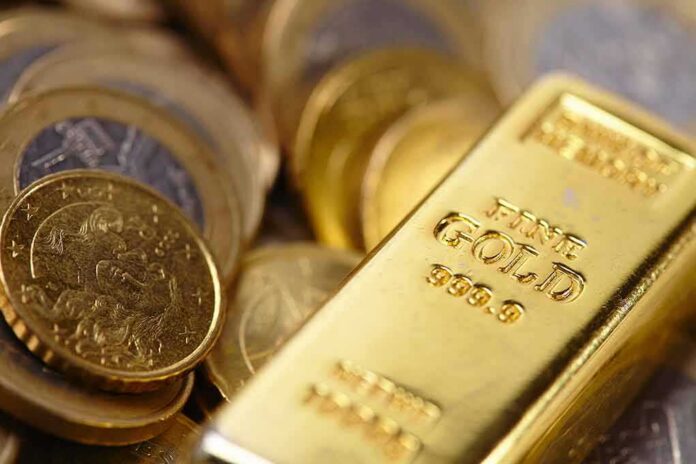
While headlines mocked a gold pullback, central banks quietly bought hundreds of tonnes, signaling a shift that challenges today’s market story and tomorrow’s safety net.
Story Snapshot
- Global gold demand hit a record in 2025, led by investors and central banks.
- Central banks kept buying at historic levels into 2025 and early 2026.
- Banks and the World Bank blame 2026’s price dip on positioning and a stronger dollar.
- Strong official demand with weaker jewelry buying shows a changing market mix.
What the data shows about demand and who is buying
The World Gold Council reported record global gold demand of 5,002 tonnes in 2025. Investment demand jumped 84 percent to 2,175 tonnes, and central banks added 863 tonnes that year. The same trend continued into 2025’s first quarter, when central banks purchased 244 tonnes, which was 24 percent above the five-year quarterly average. These facts point to steady buying from large institutions and investors, even as consumer jewelry demand softened across key markets.
Reuters said jewelry demand fell 18 percent in 2025 and Chinese jewelry buying hit its lowest level since 2009, while central-bank accumulation stayed strong. That shift matters for price behavior and policy risk. When investment and official buyers drive demand, flows can swing with rates, currencies, and geopolitics. The World Gold Council also logged full-year 2025 central-bank purchases at 863 tonnes, underscoring that reserve managers used gold to diversify in a tense global climate.
Why prices fell even as official demand stayed high
Deutsche Bank Research argued that margin hikes and heavy positioning drove a sharp unwind in precious metals during 2026, and said silver’s drop reflected speculative excess and tighter physical liquidity specific to that market. The World Bank said gold fell in the second quarter of 2026 as investors priced in more United States rate hikes and the United States dollar hit a one-year high in June. Those forces can overpower steady physical buying over short windows.
The World Bank described silver’s second-quarter drop, after a huge first-quarter surge, as a reversal in a hot market. It projected the precious-metals price index would rise 42 percent year over year in 2026, then fall 8 percent in 2027, framing a cycle rather than a collapse. The World Gold Council later noted that global gold exchange-traded-fund inflows picked up even as net long futures positions fell, showing different investor behavior by instrument.
What this means for trust, policy, and regular savers
Central-bank buying at or near record levels suggests reserve managers want more balance in their holdings. That does not prove a rush out of the dollar, but it does show a broader hedge against shocks. An International Monetary Fund note said gold can support long-term resilience but is volatile and offers only conditional hedging, which means it is not a cure-all in a crunch. In plain terms, gold can help, but it is not a magic shield.
For families and retirees, the signal is mixed but important. Big buyers keep adding gold while prices swing with rates and the dollar. That fits a world where elites and policymakers often protect their own balance sheets first, leaving savers to ride the waves. The takeaway is simple: official demand is strong and broad-based, jewelry is weaker, and price dips can still happen fast. That is not proof of a looming crash, but it is a sign to watch liquidity and leverage closely.
Sources:
china.gold.org, gold.org, reuters.com, zerohedge.com, bfsi.economictimes.indiatimes.com, 247wallst.com, tradingkey.com
© unitedfrontnews.com 2026. All rights reserved.