

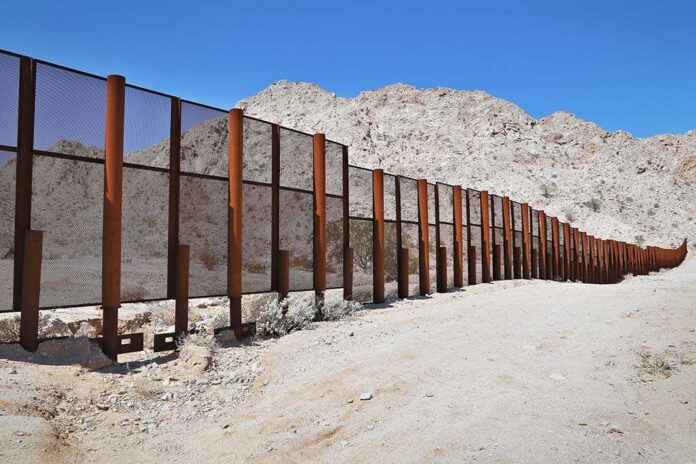
Federal agents are telling West Texas ranch families to open their gates for a new border wall or risk losing generations-old property in court.
Story Snapshot
- Big Bend and West Texas landowners are receiving federal right-of-entry letters warning that refusal could trigger lawsuits and land seizure for the border wall.
- Decades-old border laws give Washington sweeping powers to take land and even waive legal protections to speed wall construction.
- Past border projects show a pattern of low offers, sloppy surveys, and long court fights, making today’s landowners deeply wary.
- Texas blocked eminent domain for its own state wall, but that protection does not stop federal condemnations tied to national immigration policy.
Why West Texas Families Feel Cornered by New Wall Demands
Along remote stretches of the Rio Grande in West Texas, ranchers and small landowners are getting thick federal packets in the mail. These include right-of-entry construction forms that would let the government onto their property to survey and later build new wall segments tied to Congress-approved border security plans.[3] The letters warn that if owners refuse or delay, the government can go to court, condemn the land, and seize it under eminent domain, with fights limited mostly to how much money they get paid.[5]
For many families in the Big Bend region, this is not just about money. Much of this land has been in the same families for generations and carries deep history, work, and identity. Yet federal power here is real and hard to stop. Under long-standing immigration and border laws, the Department of Homeland Security can “contract for or buy any interest in land” essential to guard the border and can use eminent domain when owners do not agree to sell.[3] That leaves conservative landowners torn between backing strong borders and protecting their property.
How Federal Law Lets Washington Push Past Local Resistance
Washington’s leverage comes from laws passed years ago, long before today’s West Texas disputes. The Illegal Immigration Reform and Immigrant Responsibility Act, later expanded by the Secure Fence Act and other measures, ordered the government to install barriers, roads, cameras, and sensors along large stretches of the southern border.[3][15] These laws gave the Department of Homeland Security broad authority to decide where to build and to take land, through condemnation if needed, in the vicinity of the border.
On top of that, Congress allowed the secretary of Homeland Security to waive “all legal requirements” that might slow “expeditious construction” of border barriers and roads.[1][15] Past administrations have used that waiver power to sweep aside environmental rules and even some property safeguards so they can move faster. Investigations into earlier Texas projects found officials quietly raised appraisal thresholds and cut back on formal valuation steps, which made it easier to lowball owners and harder for them to challenge the offers.[4][7] That history now hangs over every new letter that hits a rancher’s mailbox.
Texas Tried to Protect Landowners, but Federal Power Still Rules the Line
At the state level, Texas lawmakers heard the anger from property owners and drew a firm line. For the state-run border wall program overseen by Governor Greg Abbott, the Legislature barred the use of eminent domain in 2021.[4] That means the state can only build where owners sign easements; it cannot seize land the way it can for roads or power lines. As a result, at least a third of contacted landowners have refused, leaving many Texas-funded wall segments broken up and pushed into more remote ranch country.[4]
Those state protections, however, do not stop the federal government. Under the United States Constitution’s supremacy clause and long court practice, once Congress approves a border project, federal agencies can condemn land for any purpose that reasonably serves that project.[5][15] Legal analysts note that the only real defense is to prove the government has no lawful authority to take the property, which is a very high bar.[5] In most cases, courts focus only on “just compensation,” not on whether the wall should be built there at all. That leaves Texas conservatives watching a state that respects their land rights while Washington can still steamroll them in the name of national policy.
Past Abuses Make Today’s Landowners Skeptical of Federal Promises
Border land seizures are not new, and the record from earlier rounds feeds deep mistrust today. After the Secure Fence Act, the government filed more than 360 eminent domain lawsuits to take land in South Texas when owners refused to sell.[4] More than a decade later, roughly 60 to 70 of those cases were still unresolved, mostly because families and the government could not agree on fair compensation.[4] In plain terms, many owners had already lost their land and seen fencing built while they still fought in court over the check.
In far West Texas, the threat of land seizures for a border wall has families on edge.
In the Big Bend region, where some families have lived for generations, government letters seeking access to their land is sparking fear and resistance. https://t.co/iM6GEXs14i
— Texas Tribune (@TexasTribune) June 16, 2026
An investigation by ProPublica and The Texas Tribune found that Homeland Security cut unfair deals, missed basic steps, and even paid people who did not own the land being taken.[7] Officials used waiver power to sidestep negotiation rules and raise the dollar threshold at which a formal appraisal was required, which meant most small owners never got a rigorous review of their land’s value.[4][7] Stories like these explain why today’s West Texas ranchers eye new survey packets with suspicion. They see not only a threat to their property lines but a federal system that has bent the rules before—and might do it again unless someone in Washington decides that strong borders should not come at the expense of honest, constitutional treatment of American landowners.
Sources:
[1] Web – Texas Landowners Face a Difficult Decision: Allow Border Wall or Lose …
[3] Web – Lawsuit Challenges Big Bend Border Wall Construction
[4] Web – [PDF] obstructing human rights: the texas-mexico border wall
[5] Web – [PDF] Eminent Domain Along the Southern Border: Government Seizures …
[7] Web – Response to Public Comments Regarding the Construction of …
[15] Web – Texas landowners in the Big Bend region are fighting federal efforts …
© unitedfrontnews.com 2026. All rights reserved.