

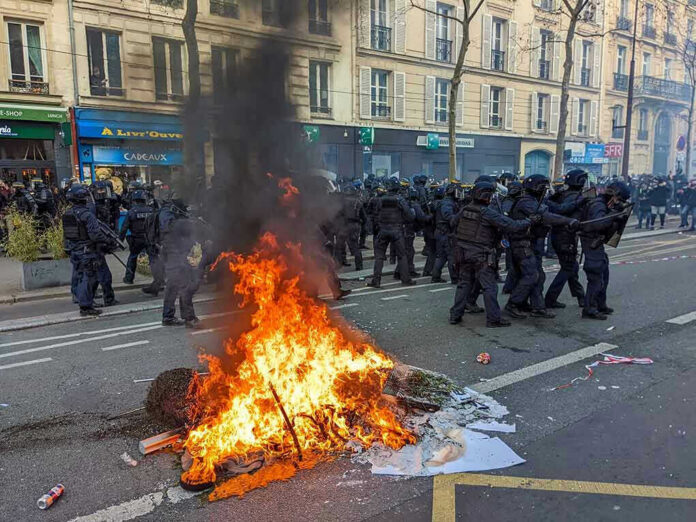
France’s government moved to let local officials ban protests after city halls and businesses were torched during nationwide unrest.
Story Highlights
- Hundreds of thousands marched; violence by smaller groups left buildings burned and streets damaged.
- President Emmanuel Macron told prefects to work with mayors and ban gatherings when needed.
- Arrest counts varied widely as police cracked down across several cities.
- Interior Minister said police could use more crowd-control tools if urban violence flared.
Macron’s Directive: Targeted Bans To Protect Public Buildings
President Emmanuel Macron addressed the nation after violent scenes followed mass protests over living costs and public services. He told local prefects to coordinate with mayors to protect city halls, schools, and shops. He said they should prohibit specific gatherings when necessary to keep order. The plan pairs security steps with talks on root causes. He said officials should hear students, teachers, and unions to draft concrete proposals in the coming days.
Paris authorities acted along these lines. The police prefect issued partial bans on declared march routes under France’s internal security law. The orders blocked riskier stretches but allowed modified demonstrations to proceed. The approach tries to separate peaceful marches from violent breakaway groups. It also signals that the right to protest still stands, but not at routes judged likely to end in attacks or arson.
Scale Of Unrest: Big Crowds, Violent Minority, And Confusion Over Arrests
Newsrooms reported large crowds across France, with several outlets putting turnout near 550,000 on October 17. Most people marched peacefully, but masked groups set fires, attacked public buildings, and looted shops in several cities. One city hall in Limoges suffered major damage after a blaze. The government condemned the violence and promised full prosecutions for those who targeted civic sites and businesses.
Arrest totals differed by outlet and time, which can happen during fast-moving events. Reports cited more than 1,200 arrests at one point, 1,800 in a later sweep, and other totals in between. Paris police alone reported hundreds of arrests in the capital area. The different figures reflect rolling counts and varied geographic scopes. A final, unified Interior Ministry tally was not available in the cited reports.
Policing Posture And Civil Liberties Tension
Interior Minister Laurent Nuñez said officers must be able to use available intermediate weapons if urban violence returned. That includes tear gas grenades and defense ball launchers under France’s rules for crowd control. Supporters call this a needed tool to stop arson and attacks quickly. Critics warn that tougher tactics can escalate tensions and risk injuries, especially when peaceful marchers stand near violent actors.
Macron’s message tried to split the difference. He backed police and said there is “no room for violence” in the Republic. He also said the vast majority protested peacefully and deserve to be heard about rising prices, fuel costs, and school conditions. The targeted-ban strategy reflects that mix: allow lawful assembly, restrict high-risk routes, and bring charges against anyone who torches a town hall or loots a shop.
Why This Matters For Americans Watching Abroad
France’s flashpoint looks familiar. Big economic stress fuels anger. A small number hijack the crowd, and then the state tightens rules. That cycle can harden distrust on both the left and right. People who fear chaos welcome tougher policing. People who fear creeping control worry about expanded powers and protest limits. The lesson is clear: governments should protect safety without normalizing emergency tools that can outlast the crisis.
What To Watch Next: Data, Accountability, And Dialogue
Key tests are coming. First, clear data on arrests, injuries, and damages can cut spin from all sides. Second, transparent prosecutions can show whether the attacks were organized or opportunistic. Third, open talks with students, teachers, and unions will reveal if the government pairs order with real reforms. If bans stay narrow and time-limited, and if dialogue yields results, trust may recover. If not, expect another round of anger in the streets.
Sources:
telegraph.co.uk, gpb.org, bbc.co.uk, cnbc.com, cnn.com, elysee.fr, euronews.com, prefecturedepolice.interieur.gouv.fr, bbc.com
© unitedfrontnews.com 2026. All rights reserved.