

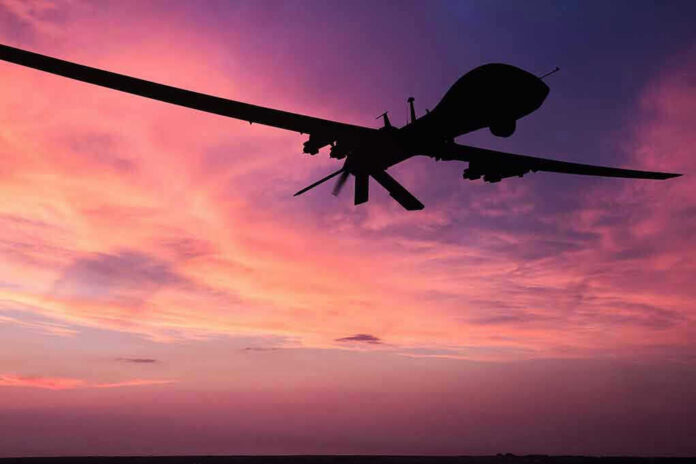
A single unidentified drone slipping toward a nuclear aircraft carrier in a NATO port shows how modern “gray-zone” pressure can probe Western defenses without firing a shot.
Story Snapshot
- Swedish forces electronically jammed an unknown drone as it approached France’s aircraft carrier Charles de Gaulle in Malmö on Feb. 25, 2026.
- The drone was stopped roughly 7 nautical miles (about 10 km) from the carrier, then disappeared from radar; its end result remains unclear.
- Multiple reports suggested a link to a nearby Russian vessel, but official confirmation of origin was limited.
- French officials said operations were not disrupted, and Sweden described the cooperation as effective.
Sweden Jams Drone Near a High-Value NATO Asset
Swedish armed forces detected an unidentified drone moving toward the French Navy’s flagship aircraft carrier Charles de Gaulle while it was docked in Malmö, Sweden, during a historic port visit tied to NATO activity. Swedish units used electronic warfare to jam the drone at a distance reported around 7 nautical miles, after which it vanished from radar. French officials later confirmed the event and said the carrier’s operations continued normally.
The key unresolved detail is what happened after the jamming. Reports said the aircraft disappeared from tracking, but whether it crashed, turned back, or continued at low signature was not publicly confirmed. That uncertainty matters because it separates a contained nuisance from a successful test of response procedures. Either way, the episode underscored that small, low-cost systems can create outsized security demands around major military platforms.
Why Malmö and the Öresund Strait Matter
Malmö sits on the Öresund Strait, a strategic chokepoint between Sweden and Denmark that connects the Baltic to the North Sea. The Charles de Gaulle stopover was described as its first in Malmö, making it a symbolic moment for Sweden’s post-neutrality security posture after joining NATO in 2024. When a drone shows up in that setting, the incident becomes more than a local police matter—it becomes a stress test of allied readiness at a politically visible location.
France’s carrier is not just another ship passing through. The Charles de Gaulle, commissioned in 2001, is France’s sole nuclear-powered aircraft carrier and a key tool for power projection with a large crew and an embarked air wing. Its presence in northern European waters ties into a broader pattern of allied exercises and deterrence missions reported around the Baltic and North Atlantic. From a conservative lens, that is exactly why hostile actors would prefer deniable “harassment” tactics over overt confrontation.
What’s Known—and Not Known—About the Drone’s Origin
Several reports pointed to a suspected launch from a nearby Russian vessel, but the most careful official framing still treated the drone as “unknown,” at least publicly. That distinction is important: suspicion based on proximity and pattern is not the same as a verified attribution. The reporting also did not settle the drone’s purpose—reconnaissance, signal collection, or simply a probe of reaction time. What can be stated confidently is that Swedish jamming worked and the carrier’s mission was not interrupted.
A Snapshot of the Baltic’s Hybrid Pressure Campaign
The drone episode landed amid broader concerns about disruptive tactics in the region—jamming, interference, and threats to critical infrastructure. NATO nations have been increasingly focused on protecting undersea cables and other strategic assets, and recent activity has kept air defenses and quick-reaction forces busy. This is the kind of security environment that rewards countries that invest in hard capabilities rather than slogans: sensors, electronic warfare, disciplined rules of engagement, and clear coordination between allies.
For Americans watching from home in 2026, the lesson is not to panic—it is to recognize that deterrence is a muscle. When adversaries can cheaply test a carrier group with a drone, the response must be fast, lawful, and capable. Sweden’s success also highlights a reality many conservatives have argued for years: defense isn’t a “nice-to-have,” and neither is national sovereignty. The public still lacks key technical details, but the incident shows why serious countries prioritize readiness over ideology.
Limited public information remains a constraint. Officials have not publicly released the drone’s type, payload, operator, or final disposition, and there was no definitive public attribution accepted across all statements. What is clear is that allied forces treated the approach as a serious security event, neutralized the immediate threat with electronic measures, and continued operations—an outcome that reduces the payoff of provocation while keeping escalation under control.
Sources:
Unknown drone jammed near French navy flagship in Sweden: forces
Russian drone intercepted near French aircraft carrier in Sweden
Security incident as French aircraft carrier Charles de Gaulle visits Malmo
Russian drone spotted over major NATO aircraft fears war surge
Russian drone spotted over major NATO aircraft fears war surge
France modernises its fleet with a new gun able to bring down a drone in 2 seconds