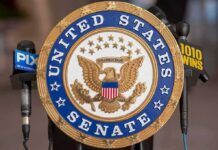


As Washington fights over war powers, a Republican Congress is moving to tie President Trump’s hands on Iran just as he claims to have the regime “on the ropes.”
Story Snapshot
- Both the House and Senate, under Republican control, have passed symbolic war powers resolutions telling Trump to pull back from the Iran war.
- Four Republican senators and four House Republicans joined Democrats, exposing a growing split inside the party over who controls decisions of war and peace.
- Trump argues broad commander‑in‑chief powers are needed to stop Iran’s nuclear ambitions and protect U.S. interests, while critics invoke the 1973 War Powers Act.
- The fight revives a 50‑year struggle over whether Congress or the White House decides when America goes to war.
Congress Rebukes Trump Over Iran War Powers
A Republican‑led House passed a resolution directing President Trump to end U.S. hostilities with Iran unless Congress declares war or approves force, by a 215–208 vote with four Republicans crossing party lines.[12] The measure is a “concurrent” resolution, so it does not go to the president’s desk and does not have the force of law, but it clearly places Congress on record against an open‑ended conflict with Iran.[3] For many lawmakers, this was a rare public pushback against any president’s war powers.
Shortly after the House vote, the Senate approved its own Iran war powers resolution by a narrow 50–48 margin, with Republican Senators Bill Cassidy, Susan Collins, Lisa Murkowski, and Rand Paul joining Democrats in support.[4] Like the House version, the Senate resolution is framed under the War Powers Act and calls on Trump to remove U.S. forces from “hostilities” with Iran unless Congress authorizes further action.[5] Supporters admit the resolution is mostly symbolic, but they say it sends a sharp warning about presidential overreach.[8]
What the War Powers Fight Is Really About
The War Powers Resolution of 1973 was passed after Vietnam to restore checks and balances on when U.S. troops can be sent into combat.[18] It says the president must notify Congress within forty‑eight hours of introducing forces into hostilities and must end those operations within sixty days unless Congress grants approval.[13] In theory, Congress can also order a president to terminate military action, but that usually requires legislation that can be vetoed, making enforcement difficult in practice.[10]
Over the last fifty years, both Republican and Democrat presidents have stretched this law by starting or expanding conflicts without formal declarations of war, citing their Article II powers as commander in chief.[17] Researchers have found that in dozens of major deployments since Vietnam, presidents relied only on claimed constitutional authority, not on clear congressional authorization.[17] Trump’s decision to launch major strikes on Iran without a specific vote fits this long‑term pattern and has now triggered a rare bipartisan backlash in Congress.[6]
Trump’s Case for Broad War Powers and Iran Funding
Trump’s team argues that strong executive power is needed to keep Iran from ever getting a nuclear weapon and to protect U.S. forces and allies in the region.[12] After joint U.S.–Israeli strikes on Iranian nuclear sites, the administration said the goal was to cripple Tehran’s nuclear and missile programs and force the regime into “strategic submission.”[7] Trump has also told supporters that oil is flowing again through the Strait of Hormuz and that Iran is “on the ropes,” proof, in his view, that pressure is working.[9]
To sustain this strategy, the Pentagon has asked for very large additional war funding, on top of an already massive defense budget.[8] Trump and his advisers frame this spending as a necessary investment to prevent a far costlier future war if Iran goes nuclear.[8] They also argue that the Constitution gives the president broad inherent authority to use force in defense of national interests, even without explicit approval from Congress, a view that many modern administrations have shared.[16]
Republican Skeptics Push Back on Constitution and Costs
Republican lawmakers who joined Democrats say their vote is not about surrendering to Iran, but about following the Constitution and forcing a debate on war and peace.[10] They point back to the text of the War Powers Act, which requires the president to get approval or end hostilities after sixty days, with only a short extension allowed for safe withdrawal.[13] Some also complain that the administration keeps shifting its goals in Iran, from regime pressure to missile strikes to nuclear talks, without a clear endgame.[8]
🇺🇸 BREAKING: US Senate passes War Powers Resolution 50-48, directing Trump to remove forces from hostilities with Iran unless Congress authorizes war — though it's symbolic and non-binding.
— Nations Affairs (@NationsAffair) June 24, 2026
Conservative critics outside Congress warn that letting any president wage an open‑ended war without a vote weakens the very constitutional system patriots are trying to defend.[15] Legal scholars note that the Constitution gives Congress, not the president, the power to declare war and fund the military, while the president’s job is to command the forces once war is authorized.[19] The Iran clash, they say, is only the latest chapter in a long struggle to keep that balance from sliding toward one‑person rule over life‑and‑death decisions.[1]
Sources:
[1] Web – Collision Course With Republicans…
[3] Web – House passes resolution to end hostilities with Iran
[4] Web – House passes resolution to end Iran war, challenging Trump
[5] YouTube – Senate approves a war powers resolution in a rebuke to …
[6] YouTube – Senate passes war powers resolution to curb future US …
[7] Web – House votes to rebuke Trump over war with Iran
[8] YouTube – Trump’s war powers rebuked by GOP-led House & Senate
[9] Web – Senate approves war powers resolution in symbolic move …
[10] YouTube – ‘Historic’: Sen. Tim Kaine on Senate war powers resolution …
[12] YouTube – House approves war powers resolution after multiple failed votes to …
[13] Web – US House votes for measure that would end Iran war, in blow to Trump
[15] Web – US House passes Iran war powers resolution in rare pushback …
[16] Web – The Unhappy Legal History of the War Powers Resolution
[17] Web – War Powers and the Return of Major Power Conflict
[18] Web – Findings and Analysis | War Powers Resolution Reporting Project
[19] Web – War Powers Resolution of 1973 | Richard Nixon Museum and Library
© unitedfrontnews.com 2026. All rights reserved.