
President Trump drew a packed Montana crowd and put local Republican races center stage, while a federal court fight over media access trailed his campaign swing.
Story Snapshot
- Trump headlined a Kalispell rally to boost House hopeful Aaron Flint and Senate candidate Kurt Alme.
- Local reports said the arena was full, with major Montana Republicans in attendance.
- The Montana stop was part of a wider midterm push across Western states.
- A judge curbed the White House’s media bans as access disputes continued.
Trump’s Montana Stop Focused on Down-Ballot Republicans
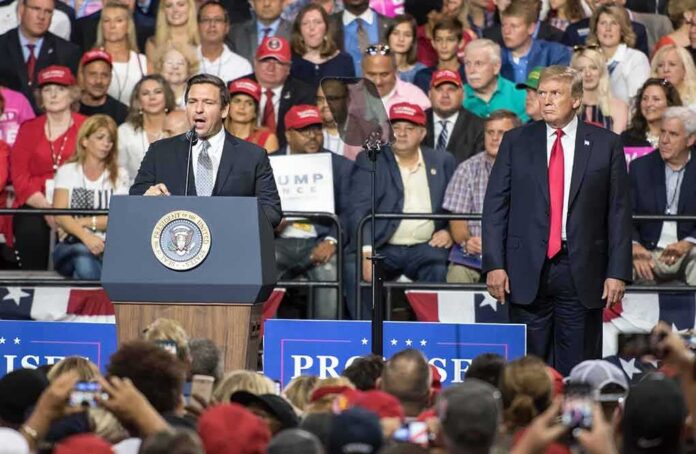
President Trump held a campaign rally on October 14, 2026, at Majestic Valley Arena in Kalispell, Montana. He urged voters to back Republican House candidate Aaron Flint and Senate candidate Kurt Alme. He also criticized Flint’s Democratic opponent, Sam Forstag. The rally aimed to help Republicans retain or gain seats in a year when presidents often face midterm losses. Trump’s message told supporters that voting Republican would protect core issues they value.
Associated Press described the Montana event as part of a focused push in the state’s Western First District. Trump promoted Republican candidates by name and called on attendees to vote. He paired that with issue language meant to fire up the base. During his remarks, he stressed gun rights, saying a Republican vote meant the Second Amendment would not be weakened. The framing fit his long-running approach to motivate turnout among conservative voters in the region.
Large Crowd and State Republican Bench Signaled Local Muscle
Local coverage reported that the arena filled up and that the crowd was energetic. The Daily Inter Lake said the rally “packed” the venue, signaling strong local interest. The Flathead Beacon described a large turnout in the Flathead Valley and listed several Montana Republicans in the house, including Senator Steve Daines and Representative Ryan Zinke. That bench support showed that the state party aligned its message with the president’s push to lift Flint and Alme down the stretch.
Montana Governor Greg Gianforte and other statewide officials were identified as participants or attendees in reports, underscoring the state-level backing for the ticket. Such visual unity can matter in low-information races. Voters who know the president may not know every candidate on the ballot. A shared stage helps transfer attention and energy to those races. That can build volunteer sign-ups and small-dollar donations, though the reporting did not include such data.
Part of a Broader Midterm Blitz, With Limits on What We Can Prove
Public Broadcasting Service described Trump’s trip as a second day of a Western roadshow. The outlet said the president’s team framed it as a midterm blitz to rally the Republican Party. The aim fit a long pattern in American politics. The president’s party often tries to blunt midterm losses with travel, rallies, and targeted messages before early voting and Election Day. That playbook seeks to boost turnout and keep the base engaged.
The research here documents the events and the messaging, but it does not show a measurable change in votes or turnout caused by the rally. There are no controlled comparisons, post-event polls, or filings that isolate a rally effect. Analysts often caution that events in friendly districts may reinforce existing support rather than persuade undecided voters. The Montana stop fit that risk profile because the First District leans Republican in recent cycles.
Media Access Fight Shadowed the Campaign Trail
As Trump traveled, a federal judge moved against parts of the White House’s media restrictions. The court blocked bans that kept certain outlets from the White House complex. The judge’s action did not resolve access to every venue or aircraft, but it checked the administration’s approach. The ruling kept First Amendment concerns in the news alongside the campaign itself. That attention risked competing with the Republican candidates’ message.
NewsNation's Vinay Simlot has the latest on President Trump's campaign tour…: “President Donald Trump is on a western swing, moving to Arizona and Montana today. In Texas, a state that last elected a Democrat to the Senate in 1988, Vice President JD Vance campaigned for Ken… pic.twitter.com/KwYHdQQd6o
— Worldwide News Network (@WorldwideNNX) October 14, 2026
Separate reporting said the White House had removed Cable News Network from the press pool for a Texas and Oklahoma trip. That decision kept the access dispute in the spotlight during the broader midterm push. Reuters added that television networks adjusted coverage as the fight played out. The mix of campaign news and legal wrangling showed how power, press access, and elections can collide in Washington. It also fed wider public worries about gatekeepers and open government.
Why This Matters Beyond One Rally
Since World War Two, the president’s party has lost House seats in most midterms. That pattern shapes how both parties act in the fall. Campaigns surge into safe and swing areas to raise energy, money, and turnout before votes are cast. Rallies are a key part of that push. They can focus attention, draw volunteers, and help local candidates borrow the spotlight. Whether they change many minds is less clear in the data.
Sources:
youtube.com, apnews.com, washingtonpost.com, nbcnews.com, pbs.org, dailyinterlake.com, reuters.com, flatheadbeacon.com
© unitedfrontnews.com 2026. All rights reserved.