
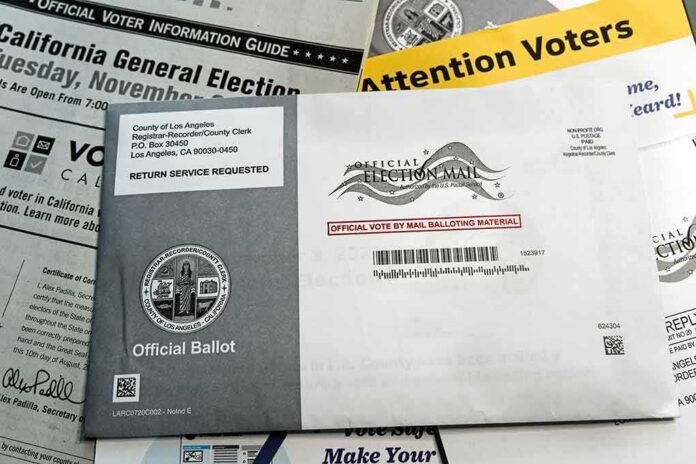
In a rare federal-to-state showdown over ballots already in the mail, the Justice Department moved to halt California from counting votes tied to more than 20,000 registrants flagged as likely noncitizens.
Story Snapshot
- The Justice Department asked a federal court to require California to set aside specific mail ballots until citizenship is verified.
- Federal officials say a joint federal list identified over 20,000 likely noncitizens on California’s rolls.
- California’s top election official says Washington has not provided proof and warns against mass disenfranchisement.
- The legal clash centers on timing rules and how reliable database matching is close to an election.
What the Lawsuit Seeks and Why It Matters
The Justice Department filed suit in federal court asking a judge to order California to set aside ballots linked to a defined list of registrants until officials confirm each person’s citizenship. The department says it worked with the Department of Homeland Security to build the list, and stresses that it is seeking verification, not an automatic purge of votes. The case targets ballots for a federal election, which gives Washington a direct stake in the outcome and the requested remedy.
Federal lawyers say they gave California a device with the names and asked counties to review those records, segregate any returned ballots from those voters, and verify status before counting. Reporting describes a short turnaround for state action that raised local capacity concerns. The department frames the step as temporary and focused: identify the ballots, verify citizenship, then count those confirmed as eligible. The court filing asks for judicial orders, not unilateral federal control.
California’s Pushback and Fears of Wrongful Disenfranchisement
California Secretary of State Shirley Weber says the federal government has not provided evidence that the listed people are noncitizens and warns against blocking thousands of votes based on unproven claims. Weber’s office says the list lacked the detail and function needed to investigate names and resolve cases quickly. State officials also question whether any listed registrants actually returned ballots, arguing the demand risks disenfranchising eligible voters without clear proof.
California also points to timing rules in federal law. The National Voter Registration Act limits systematic list maintenance within 90 days of a federal election. Courts and briefs have debated how that “quiet period” applies, especially where the issue is eligibility that may never have been valid in the first place. The lawsuit forces a fast ruling on whether segregating ballots and checking citizenship is lawful list work or an improper late-stage change.
The Core Dispute: Evidence Quality Versus Election Timing
The heart of the fight is the accuracy and use of database matching under election deadlines. The Justice Department says federal cross-checks flagged more than 20,000 likely noncitizens, and it wants case-by-case confirmation before counting. California counters that “likely” is not proof and that the federal government has not shown how it matched records or its error rate. Without shared methodology, both sides are asking voters to trust their institutions rather than verified data.
𝐃𝐎𝐉 𝐁𝐘𝐏𝐀𝐒𝐒𝐄𝐒 𝐀 𝐒𝐈𝐋𝐄𝐍𝐓 𝐉𝐔𝐃𝐆𝐄, 𝐑𝐔𝐒𝐇𝐄𝐒 𝐂𝐀𝐋𝐈𝐅𝐎𝐑𝐍𝐈𝐀’𝐒 𝟐𝟎,𝟎𝟎𝟎 𝐍𝐎𝐍𝐂𝐈𝐓𝐈𝐙𝐄𝐍 𝐁𝐀𝐋𝐋𝐎𝐓𝐒 𝐓𝐎 𝐓𝐇𝐄 𝟗𝐓𝐇 𝐂𝐈𝐑𝐂𝐔𝐈𝐓
The Justice Department asked a federal judge Monday to freeze the counting of California mail ballots tied… pic.twitter.com/nUpq9CKpzD
— M.A. Rothman (@MichaelARothman) October 23, 2026
Past research shows cross-database matching can misfire when records lack a common identifier or are outdated, creating false matches that can hurt eligible voters. That risk rises under tight timelines. The Justice Department’s request is narrow in theory—segregate, then verify—but execution depends on clear data, a sound process, and enough time. A court order will likely set the guardrails for what checks are allowed close to Election Day and what proof states must see to act.
Sources:
nypost.com, justice.gov, politico.com, washingtontimes.com, abc7news.com, foxnews.com, electionlab.mit.edu
© unitedfrontnews.com 2026. All rights reserved.