

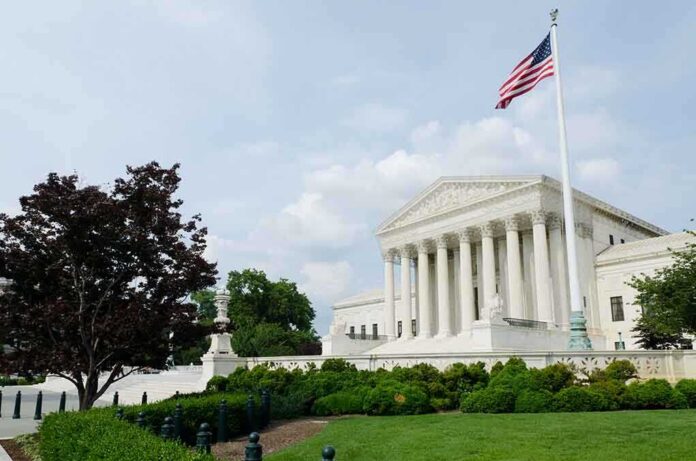
A Supreme Court decision empowers political candidates to challenge the legality of counting late mail-in ballots, igniting hope among conservatives for stricter election integrity.
Story Highlights
- Supreme Court ruling allows candidates to sue over late mail-in ballot laws.
- Seen as a victory for election integrity advocates challenging Democrat-favored deadlines.
- Ruling could lead to nationwide challenges against post-Election Day ballot counting.
- Focuses on procedural standing, not the legality of counting late ballots.
Supreme Court Ruling on Late Ballots
On January 14, 2026, the U.S. Supreme Court ruled 7-2 in the case of *Bost v. Illinois State Board of Elections* that political candidates have the legal standing to challenge state laws that permit the counting of mail-in ballots received after Election Day, provided they are postmarked by Election Day. This ruling, celebrated by election integrity advocates, opens the door to nationwide challenges against practices that are perceived to undermine electoral fairness.
The case originated from a lawsuit filed in 2022 by Illinois Republican congressional candidate Rep. Michael Bost and others, arguing that Illinois law violated federal statutes by allowing such ballots. Lower courts had dismissed the case for lack of standing, but the Supreme Court’s decision now allows it to proceed, focusing solely on procedural standing without ruling on the merits of the ballot counting issue.
HUGE WIN FOR ELECTION INTEGRITY: Supreme Court Greenlights Lawsuits Against Late Mail-In Ballots — Opens Door to Nationwide Challenges to Democrat Schemes https://t.co/fSjVFAiVtQ #gatewaypundit via @gatewaypundit
— Kerry 🇺🇸 (@K1erry) January 14, 2026
Impact on Election Integrity
This ruling has significant implications for states with post-Election Day receipt windows, affecting approximately 20 states. With the Supreme Court’s decision, political candidates can now legally challenge these laws, potentially leading to injunctions and changes ahead of the 2026 midterm elections. The decision reflects a broader conservative push for election integrity, aiming to prevent perceived election irregularities linked to extended ballot counting deadlines.
While the ruling is hailed as a victory by conservatives, it also raises concerns among those advocating for broader voter access. The decision does not address the merits of counting late ballots, leaving the legal status of such practices unresolved. This procedural clarification could lead to increased litigation, as warned by dissenting justices who fear a “floodgate” of lawsuits challenging election processes.
Looking Ahead: Future Challenges
As the *Bost* case returns to lower courts for further review, attention now turns to related cases, such as those pending in Mississippi, which will directly test federal preemption of state receipt deadlines. These cases could further shape the landscape of election laws and practices, potentially leading to a standardized Election Day receipt requirement nationwide.
The implications of these legal battles extend beyond the courtroom, impacting candidates, election administrators, and voters, particularly those in rural and disabled communities who rely on mail-in voting. As the nation prepares for the upcoming elections, the ongoing debate over election integrity and voter access remains a central issue.