
The Supreme Court just handed federal bureaucrats a free pass to deliberately withhold your mail without consequence, and Americans seeking accountability are left with nowhere to turn.
Story Snapshot
- Supreme Court’s 5-4 ruling shields USPS employees from lawsuits even when they intentionally refuse to deliver mail
- Texas landlord Merly Konan alleged postal workers deliberately withheld her mail due to racial bias, harming her rental business
- Decision expands federal immunity beyond accidental errors to include purposeful misconduct by government employees
- Four justices dissented, warning the ruling rewrites congressional intent and eliminates recourse for deliberate federal malfeasance
Supreme Court Expands Federal Immunity Shield
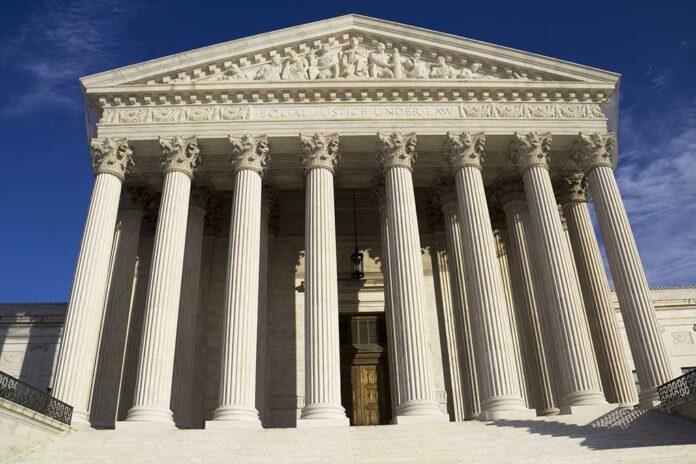
The Supreme Court ruled on February 24, 2026, that the United States Postal Service cannot be sued under the Federal Tort Claims Act for intentionally misdelivered or withheld mail. Justice Clarence Thomas authored the 5-4 majority opinion in United States Postal Service v. Konan, holding that the FTCA’s postal exception bars lawsuits for any mail handling failure, regardless of whether postal workers acted negligently or deliberately. The decision reverses the Fifth Circuit Court of Appeals, which had ruled that intentional nondelivery falls outside statutory immunity protections designed for accidental mistakes.
Landlord’s Discrimination Claims Blocked by Broad Immunity
Merly Konan, a Texas landlord, filed suit after postal workers allegedly refused to deliver her mail due to racial discrimination, causing disruption to her rental business operations. She claimed emotional distress, business interference, and civil rights violations under the Federal Tort Claims Act. The District Court dismissed her claims under the FTCA’s postal exception codified in 28 U.S.C. § 2680(b), which exempts claims “arising out of the loss, miscarriage, or negligent transmission of letters or postal matter.” The Fifth Circuit reversed, distinguishing intentional refusal from negligent handling, but the Supreme Court reinstated the blanket immunity.
Dissent Warns of Unchecked Government Power
Justice Sonia Sotomayor led a forceful dissent joined by Justices Kagan, Gorsuch, and Jackson, arguing the majority improperly rewrote congressional intent by extending immunity beyond accidental failures to deliberate misconduct. The dissenters contended that terms like “loss” and “miscarriage” refer to unintentional errors, not purposeful refusal to deliver mail. This interpretation matters because it eliminates legal recourse for Americans victimized by federal employees who intentionally weaponize mail services. The unusual coalition of liberal and conservative justices in dissent underscores concerns about unchecked government power that should alarm anyone valuing accountability and limited government.
Mail-Dependent Businesses Face Increased Vulnerability
The National Newspaper Association criticized the ruling for putting publications and small businesses at risk by removing accountability for delivery failures that threaten their operations. NNA Chair Martha Diaz Askenazy urged Congress to enforce USPS responsibility, highlighting how mail-dependent industries now face increased vulnerability to service disruptions with no legal remedy. Small businesses, landlords, and publishers who rely on timely mail delivery for invoices, legal notices, and customer communications cannot sue even when postal employees deliberately interfere with their operations. This expands federal immunity beyond protecting government efficiency into shielding intentional harm against private citizens and businesses.
The Postal Service's Recent Supreme Court Win Is Bad News for Government Accountabilityhttps://t.co/0zvWIh5DDo
— José Colón (@JoseEColon) February 26, 2026
The decision represents another example of federal agencies operating above accountability standards applied to private citizens. When government employees can intentionally withhold mail without legal consequence, it creates a two-tiered justice system incompatible with constitutional principles of equal protection and limited government. Congress established the FTCA in 1946 to waive sovereign immunity for federal employee torts, but the postal exception was designed to prevent frivolous lawsuits over accidental delivery delays, not to protect deliberate misconduct. The Court’s expansion of this exception beyond congressional intent weakens the checks on federal power that protect individual liberty and property rights.
Sources:
Supreme Court rules Postal Service can’t be sued over misdelivered mail
Supreme Court Decides United States Postal Service v. Konan
The Postal Service’s Recent Supreme Court Win Is Bad News for Government Accountability
Court holds that U.S. Postal Service can’t be sued over intentionally misdelivered mail
United States Postal Service v. Konan – Supreme Court Opinion
The Supreme Court Just Gave USPS a Free Pass to Mishandle Your Mail