
Kuwait’s newly released surveillance videos show a drone slamming into its main airport terminal, igniting urgent questions about Iranian-backed aggression and regional security that Americans cannot ignore.
Story Highlights
- Kuwait publicized multi-angle airport CCTV showing a drone striking Terminal 1, causing fatalities and injuries [1][2].
- Kuwait attributes the attack to Iran-linked drones; Iran-affiliated voices deny responsibility without providing forensic proof [2][4].
- United States statements, reported in coverage, rejected claims that a defensive interceptor caused the damage [4].
- The incident fits a wider pattern where visuals and official briefings precede full forensic attribution in the region [2][7][8].
Kuwait’s Footage Shows Direct Drone Impact On Airport Terminal
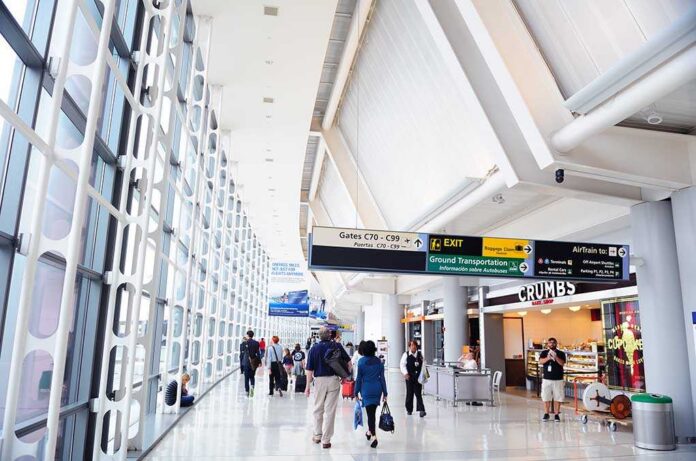
Kuwait’s Directorate General of Civil Aviation released surveillance video that captures a drone striking Terminal 1 at Kuwait International Airport from multiple angles, depicting the moment of impact and immediate damage. Reporting states the attack killed at least one person, injured dozens, and briefly disrupted operations at the country’s primary gateway, underscoring both human cost and infrastructure vulnerability [1][2]. The public release aimed to document the event clearly and establish a factual baseline while attribution and accountability are evaluated [1][2].
Kuwaiti authorities framed the incident as an Iranian or Iran-linked drone strike on a civilian target, emphasizing the deliberate targeting of an airport terminal used by travelers and workers [3]. The characterization aligns with initial regional reporting that described Iranian drones causing heavy damage and casualties. The release of the footage provides visual confirmation of a drone impact rather than an internal explosion, supporting Kuwait’s narrative that an external unmanned aircraft penetrated airspace and hit the facility directly [2][3].
Iran-Linked Denials Collide With Visual Evidence And U.S. Rebuttal
Iran-affiliated voices disputed responsibility and suggested alternative explanations, including claims that a defensive interceptor, not a drone, caused the destruction. However, publicly available material does not include telemetry, wreckage analysis, or documented chain of custody to substantiate that counter-claim [4]. United States statements, as reflected in contemporaneous coverage, rejected the interceptor explanation, reinforcing that the video shows a drone impact consistent with Kuwait’s account rather than a missile-defense malfunction [4].
This clash of claims mirrors a recurring pattern in Gulf security crises: video evidence and immediate official statements shape public understanding before exhaustive forensic analysis concludes. Regional incidents often involve contested attributions for days or weeks, particularly when state-backed actors face strategic incentives to deny direct involvement. In this case, Kuwait’s footage and casualty reports anchor the reality of the strike, while attribution remains under intensified scrutiny by authorities and partners [2][7][8].
Strategic Stakes For Americans: Airspace Security, Deterrence, And Civil Targets
Kuwait’s airport strike highlights growing use of relatively low-cost drones to threaten high-value civilian infrastructure, a challenge the United States and allies have confronted from the Middle East to Eastern Europe. The footage underscores that airports, energy hubs, and transport nodes remain prime targets for proxy aggression, coercion, or retaliation campaigns. Such attacks test deterrence, air-defense layering, and information credibility at once, putting a premium on reliable sensors, rapid attribution, and firm diplomatic messaging [1][2][7].
A drone strike hit Terminal 1 of Kuwait International Airport, and dramatic surveillance footage shows the exact moment of impact followed by a powerful explosion. The blast caused a section of the terminal roof to collapse and triggered large fires and thick smoke across the… pic.twitter.com/8b1MU14zEI
— The Pioneer (@TheDailyPioneer) June 4, 2026
For Americans who prioritize secure borders, strong defense, and clear red lines against state-sponsored terror and proxy warfare, the lesson is direct: weakness invites escalation. Visual confirmation of a drone striking a civilian terminal is not an abstract debate—it is a real-world stress test of air defenses and allied resolve. The United States benefits when partners rapidly expose facts, reject disinformation, and coordinate consequences that increase the costs for those who target civilians and critical infrastructure [2][4][7][8].
Accountability And Next Steps: Evidence, Partners, And Policy
Authorities will likely compile debris analysis, radar tracks, and intelligence reporting to finalize attribution and inform responses. Meanwhile, Kuwait’s publication of corroborating video supports immediate security adjustments at airports and other sensitive sites. For Washington and regional partners, the priority is enhancing counter-drone detection, tightening rules of engagement that protect civilian hubs, and reinforcing deterrence through credible, evidence-backed attribution that withstands denial campaigns designed to confuse the public [1][2][7][8].
Sources:
[1] YouTube – Kuwait releases surveillance video of deadly drone strike on its …
[2] Web – Video shows drone strike on Kuwait airport
[3] YouTube – Kuwait Shares Footage Of Iran-Linked Drone Strike On …
[4] YouTube – US Rejects Iran’s Patriot Missile Claim Over Kuwait Airport …
[7] YouTube – Kuwait Releases Video Of Iranian Drone Strike On …
[8] YouTube – Kuwait airport hit by drone as Iran, U.S. trade strikes
© unitedfrontnews.com 2026. All rights reserved.