

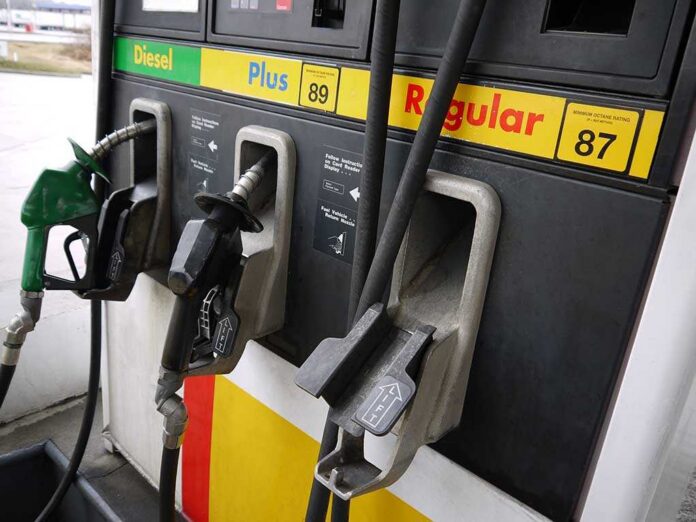
California drivers are paying over $7 per gallon at some gas stations as the Trump administration’s military strikes against Iran disrupt global oil supplies and triple tanker shipping costs to the Golden State.
Story Snapshot
- California’s average gas price hits $6.11 per gallon—54% higher than the national average of $3.97—with some stations charging over $7
- U.S. and Israeli military action against Iran in March 2026 triggered supply chain disruptions that tripled tanker shipping costs to California
- State regulators launched price-gouging investigations into stations charging $7-$8 per gallon while experts warn prices could reach $8.43
- California’s lack of pipeline connections to mainland refineries leaves it uniquely vulnerable to foreign oil supply shocks
- Low-income households now spend 8-10% of income on fuel compared to 2-3% for wealthier families, deepening economic inequality
Geopolitical Conflict Drives California’s Energy Crisis
California motorists face gasoline prices averaging $6.11 per gallon for regular unleaded as of May 2026, with individual stations in remote coastal areas like Gorda charging $7.59 and a downtown Los Angeles Chevron reaching $8.71. The price surge stems directly from March 2026 military strikes by the United States and Israel against Iran, which created immediate uncertainty in global oil markets and caused tanker shipping costs to triple. California imports over 60% of its petroleum via tanker from Middle Eastern, African, and Latin American sources due to the state’s geographic isolation from national pipeline networks. This dependence on foreign oil delivered by sea makes California uniquely vulnerable to geopolitical supply disruptions.
Market Fundamentals Compound Supply Chain Shock
The transition to summer-blend gasoline—mandated by California’s strict environmental regulations—adds an additional 15-17 cents per gallon to prices at precisely the moment supply chain disruptions are hitting hardest. California’s specialized fuel formulations require compliance from a limited pool of refineries capable of producing cleaner-burning gasoline, further restricting supply options. The state produces only 40% of its petroleum needs domestically, with no interstate pipeline connections to major producing states like Texas or Oklahoma. Tanker shipping companies are capitalizing on the crisis, with freight costs remaining elevated months after the initial Iran strikes. These structural vulnerabilities expose California consumers to price volatility that residents in pipeline-connected states largely avoid.
Working Families Bear Disproportionate Burden
Low-income California households earning under $50,000 annually now allocate 8-10% of their income to fuel costs, compared to just 2-3% for higher earners, according to economic analysis. The average California driver is spending $200-300 more monthly on gasoline compared to pre-crisis levels, forcing families to cut discretionary spending on essentials. Commercial drivers, delivery services, and small businesses dependent on transportation face margin compression as costs surge 15-25% with limited ability to pass increases to customers. Rural communities suffer disproportionately due to longer commutes, limited public transit options, and geographic isolation from employment centers. This regressive tax on mobility underscores how federal geopolitical decisions and state energy policies combine to punish working Americans with the least financial cushion.
Regulatory Response Exposes Limited Government Tools
California’s Division of Petroleum Market Oversight launched formal price-gouging investigations targeting stations charging $7-$8 per gallon, but state regulators struggle to distinguish legitimate cost pass-through from exploitative pricing. Governor Gavin Newsom blamed the Trump administration for triggering a “global price shock” with “no plan to protect families,” while simultaneously rejecting increased domestic drilling as a solution. Energy experts Michael Mahey of USC and Kate Gordon of California Forward predict worst-case scenarios reaching $8.43 to potentially $10 per gallon if the Iran conflict persists. The regulatory impasse reveals a fundamental truth: government officials lack effective tools to control prices driven by supply-and-demand fundamentals, yet continue implementing policies that restrict domestic production and increase dependence on foreign oil transported at escalating costs.
California’s gasoline crisis illustrates how ordinary citizens pay the price for decisions made by political elites in Washington and Sacramento who remain insulated from the consequences. The combination of federal military intervention and state environmental regulations creates a perfect storm that devastates household budgets while politicians point fingers rather than pursuing energy independence. Until California develops pipeline infrastructure, expands refinery capacity, or fundamentally rethinks its dependence on foreign oil, residents will remain hostages to global conflicts and supply chain vulnerabilities that elected officials seem unwilling or unable to address.
Sources:
Gas station in San Francisco charging $7 per gallon
Fact or Fiction: California gas station charging $7 per gallon