

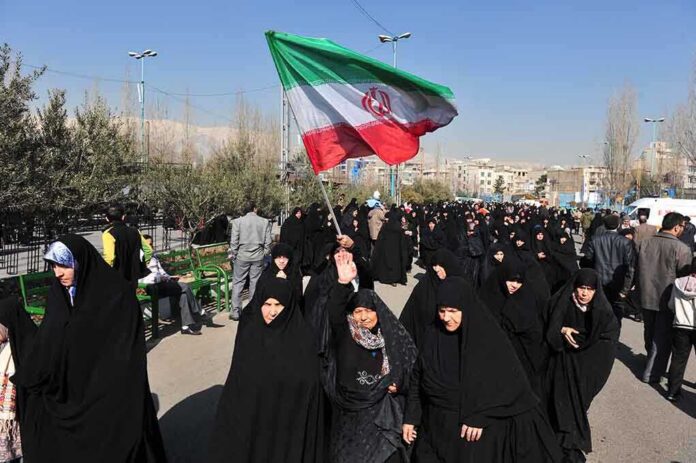
Iran’s massive, tightly managed funeral for Ali Khamenei is less about grief than about power, and it sends a warning message to both the United States and the Iranian people.
Story Snapshot
- Huge black-clad crowds filled Tehran as a six-day funeral for Ali Khamenei began, with state media touting numbers in the tens of millions.
- Reports from inside Iran describe forced attendance, business shutdowns, and pressure on charities, raising doubts about how much support is truly voluntary.
- The regime is using the funeral to turn anger over a United States–Israeli strike into anti-American and anti-Israeli chants and calls for revenge.
- The event fits a long pattern: authoritarian governments stage giant gatherings to project strength and unity, even when large parts of the population are angry or afraid.
Tehran fills with mourners as Khamenei’s funeral begins
On July 4, vast crowds of Iranians dressed in black massed in Tehran for the start of a six-day state funeral for slain Supreme Leader Ali Khamenei. State television showed people lining streets and filling the Imam Khomeini Grand Mosalla, visiting his casket and chanting “death to America” and “death to Israel.” Officials and state-linked outlets have floated estimates that 10 to 20 million people could attend ceremonies in Tehran and other cities over the coming days.
Iranian media are framing the turnout as proof the Islamic Republic has survived the opening strikes of the United States–Israel war and remains strong. Commentators compare the scenes to earlier huge funerals, like Ayatollah Ruhollah Khomeini’s in 1989 and General Qasem Soleimani’s in 2020, which also drew enormous crowds and were promoted as “shows of strength” against foreign enemies. Foreign delegations from more than 100 countries have been invited to attend, bolstering the image of global support.
Coercion, closed businesses, and a divided public
At the same time, opposition-aligned outlets and worker accounts describe a different picture behind the cameras. Public-sector employees say their bosses ordered them to attend official ceremonies, canceled all leave, and warned that absence could bring punishment. Shopkeepers in Tehran report being visited by members of the Basij militia, who told them to close during funeral hours or risk having their businesses sealed shut. Local officials also reportedly summoned charities and pressured them to contribute food and logistics under threat of disruption.
These reports of mandatory attendance and forced closures match a wider pattern seen in earlier Iranian funerals and rallies. During Soleimani’s funeral, for example, the government used heavy mobilization to draw crowds while many people felt “required” to show up, even if their feelings about the regime were mixed. Today’s Iran is sharply polarized: Reuters and other outlets document both large mourning gatherings and pockets of celebration or quiet relief after Khamenei’s killing in February. Many Iranians who blame him for decades of repression and economic pain have stayed off the streets but voice anger online or in private.
From mourning ritual to political signal
Khamenei was killed on February 28 during joint United States–Israeli airstrikes on Tehran at the start of the current war, according to Iranian and Western reporting. The funeral narrative leans hard on his “martyrdom,” with red banners for vengeance, slogans like “We must rise,” and mourners promising to stand by the system “to the end.” International media note that the claim he and his family died in a specific United States–Israeli strike is presented by Iran as fact but has not yet been independently verified in full detail.
Large crowds gather in Tehran for the funeral rites of Ali Khamenei, some with vengeance on their minds.
Sky's international affairs editor @DominicWaghorn reports from Tehran during nearly a week of planned funeral rites for the former supreme leader who was killed in an… pic.twitter.com/C9gDwEesyV
— Sky News (@SkyNews) July 4, 2026
For Iran’s rulers, the funeral is also a strategic gamble. Counterterrorism experts describe it as a “target-rich” gathering of top leaders and security forces, meant to show the regime believes a fragile peace deal with the United States will hold. The choice to open the ceremonies on July 4, the 250th anniversary of American independence, is seen as deliberate theater—a way to answer United States power with images of revolutionary defiance. In the wider study of authoritarian politics, such mass events are a classic tool: regimes use huge, emotional crowds to project unity, drown out dissent, and turn genuine grief, fear, or anger into support for the ruling elite.
Sources:
theamericanconservative.com, standardmedia.co.ke, nbcnews.com, bbc.com, wsj.com, npr.org, nytimes.com, aljazeera.com, youtube.com, facebook.com, hawaii.edu
© unitedfrontnews.com 2026. All rights reserved.