
Washington once kicked a NATO ally out of the F-35 program over Russia’s S-400—because U.S. officials feared the system could learn too much about America’s stealth jets.
Story Snapshot
- The S-400 can detect stealth jets at long range, but weapons-quality tracking is the hard part.
- The United States removed Turkey from the F-35 program over S-400 security risks.
- Public estimates say an S-400 might only target an F-35 at short ranges, if at all.
- No verified combat has tested S-400 performance against F-22 or F-35 aircraft.
What Prompted Fears About S-400 And U.S. Stealth
Pentagon leaders treated the S-400 as more than a sales brochure. In 2019, the United States began removing Turkey from the F-35 program after Ankara bought the S-400. Officials warned the Russian system could collect sensitive data on the F-35’s low-observable features, risking long-term security. Congress reporting and statements from defense officials tied the ejection directly to those risks, showing Washington took the threat seriously, even without combat proof.
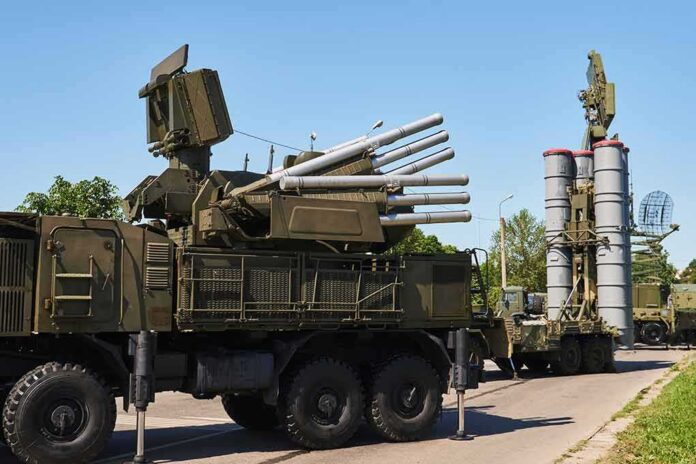
Russia’s S-400 links a search radar, a fire-control radar, and several missile types. Advocates cite headline figures: a surveillance radar that can spot many targets far away and a missile advertised to reach hundreds of kilometers. But detection is only the first link in a long “kill chain.” The system still must track, build a precise target path, guide a missile, and achieve a hit. Stealth aims to break that chain, especially at the tracking and guidance steps.
Detection Is Not The Same As A Weapons Lock
Technical summaries explain that low-frequency radars may notice a stealth jet’s presence, but they usually cannot give the precise track needed to fire a missile. The S-400’s engagement radar works at higher frequencies that stealth designs try to defeat. Analysts and open studies estimate that a weapons-quality track against an F-35 might not occur until the jet is very close, possibly around twenty miles, depending on conditions. Such figures rely on modeling and should be treated as estimates.
A former U.S. Navy operations specialist makes the same point in simpler terms. He argues that the S-400 can detect an F-22 or F-35 at some distance but likely cannot lock and guide a weapon until the aircraft moves much closer. He places a rough lock range at twenty to thirty miles, while noting that exact numbers are classified. His view echoes the broader theme: early detection does not mean a successful engagement against stealth.
What We Know, What We Do Not Know
There is still no verified combat where an S-400 has engaged an F-22 or F-35. That gap matters because manufacturer claims and estimates remain untested in real battle. One review notes that performance claims often draw from brochures, not field results. Until combat evidence appears, the strongest confirmed fact is the U.S. decision-making around risk: Washington acted as if S-400 proximity could expose sensitive stealth data and moved to prevent that outcome.
For readers who distrust official Washington, this case cuts both ways. The government acted to shield a crown jewel program, but did so with limited public proof, citing classified risks. For those angry at foreign threats, the episode shows how rival systems can pressure American advantages. For those worried about waste, it shows how a single foreign buy can disrupt a trillion-dollar fleet plan. The shared concern is clear: when strategy, secrecy, and massive costs collide, citizens want straight answers and real results.
Sources:
war.gov, congress.gov, 19fortyfive.com, reuters.com, globalsecurity.org, en.wikipedia.org, militarymachine.com, theaviationgeekclub.com, defenseone.com
© unitedfrontnews.com 2026. All rights reserved.