

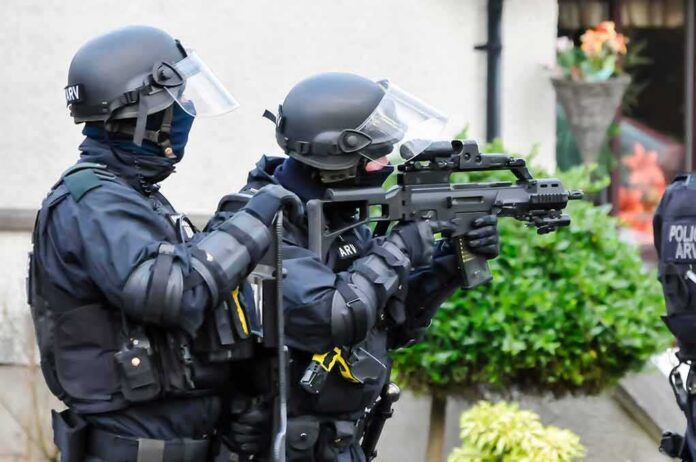
Police say paramilitary members showed up at anti-migrant riots, while leaders deny ordering the chaos — and race hate crime has hit record highs.
Story Snapshot
- Police reported loyalist paramilitary members were present during racist rioting in Belfast, but no proof leaders coordinated it.
- Senior officers said online calls pushed people to “come prepared for disorder” with an anti-immigration theme.
- Independent monitors found evidence of paramilitary involvement in racist incidents, yet not leadership-level direction.
- Race hate incidents in Northern Ireland reached the highest levels since records began, signaling a deeper shift in violence.
What Police Confirmed About the Riots
The Police Service of Northern Ireland Chief Constable told a public board that members of loyalist paramilitary groups were present at racist rioting in Belfast. He said some individuals helped direct violence at certain locations. Police also stressed they had no evidence that loyalist leadership coordinated the wider unrest. That line draws a clear boundary between individual actors and group command, which has shaped how officials frame the threat so far.
A separate senior officer briefed lawmakers that online calls urged protesters to come ready for disorder. He said these messages had a strong anti-immigration and extreme right-wing theme. Police linked much of the mobilization to social media activity, including accounts inside and outside Northern Ireland. That digital push, rather than clear orders from armed groups, is what officers said drove turnout and tactics on the ground.
What Independent Monitors and Data Show
The Independent Reporting Commission, which tracks paramilitarism, reported evidence that paramilitary members took part in racist incidents around immigration. But the commission said police did not have proof that leadership bodies organized or sanctioned the actions. This distinction matters for prosecutions, community trust, and strategy. It suggests a volatile mix of lone actors, informal networks, and crowd dynamics, more than a single chain of command.
Official statistics show the deeper shift. Race hate incidents and crimes in Northern Ireland reached record highs since the data series began in 2004 to 2005. The trend means race-targeted harm now rivals or surpasses older sectarian patterns. This rise did not start this summer, but the latest unrest has made it more visible. The numbers point to pressure in neighborhoods that feel left behind, and to online agitators who exploit that anger.
How Cross-Community Anger Fueled Unrest
Police testimony described cross-community participation in protests with an anti-immigration theme. That means some people from both loyalist and republican areas responded to calls for action. Reports noted unusual scenes of British loyalists and Irish nationalists protesting near one another with shared slogans against migrants. That overlap shows how economic strain, housing stress, and identity fears can briefly align groups that usually oppose each other.
Police also said the strongest common driver was online messaging that promised fast answers and cast migrants as the cause of local decline. That message landed in areas hit by job loss, closed services, and rising living costs. When the state appears slow or absent, street actors rush in. Communities then face a grim choice: let fear rule the block or rely on a system many believe has failed them. This is how a spark becomes a season of unrest.
Why This Matters Beyond Northern Ireland
United States readers will recognize the pattern. When people see leaders protect their own power while costs rise, they stop trusting official plans. That vacuum lets fringe voices claim to defend “the people” while targeting the newest neighbor. In Northern Ireland, that target is migrants. In the United States, it shifts by town. The lesson is the same: if government cannot keep order and deliver basics, someone else will try — often with menace, not mercy.
Policy answers must match the facts. Police should keep separating individual paramilitary actors from formal command, and charge crimes where proof exists. Officials should invest where hate crime is highest, protect threatened families, and support witnesses. Platforms should disrupt organized calls for violence while guarding lawful speech. None of this fixes broken trust overnight. But precise policing, real services, and clear rules are how a free society pushes back against mob rule.
Sources:
nytimes.com, wsws.org, bbc.com
© unitedfrontnews.com 2026. All rights reserved.