
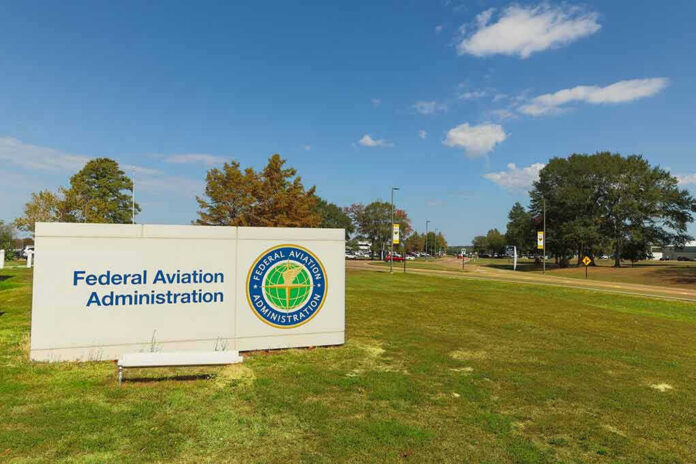
One overworked router in Arkansas helped freeze America’s skies for hours, exposing how fragile the nation’s air traffic backbone has become.
Story Snapshot
- The Federal Aviation Administration (FAA) tied the ground stop to a data flood that destabilized legacy network gear, not a cyberattack.
- Investigators zeroed in on sites in El Dorado, Arkansas, and Amarillo, Texas, linked to a router deployment and fiber transition.
- The outage halted departures nationwide for hours before traffic resumed that evening.
- Government reviews show many FAA systems are old and hard to sustain, raising wider safety and reliability concerns.
What Triggered the Nationwide Ground Stop
The Federal Aviation Administration said a network failure, not hackers, forced a nationwide ground stop on November 13. FAA officials reported that legacy equipment became unstable when data flooded the FAA Telecommunications Infrastructure at about 1,000 connection attempts every four to five seconds. That surge disrupted aircraft communications and radar feeds. The agency stabilized the system and resumed traffic by 8:15 p.m. Eastern time that day, but only after hours of delays and cancellations.
Transportation officials traced the abnormal traffic to two facilities. Investigators focused on an FAA radio site in El Dorado, Arkansas, where a contractor was deploying a router during a shift from copper lines to fiber, and a radar site in Amarillo, Texas. Gear at these sites overloaded the communications system used by controllers who guide pilots, according to people briefed on the probe and agency statements.
Why One Local Failure Rippled Nationwide
The data flood spread because the network still relies on aging equipment and broad links across facilities. When the gear failed under load, it sent bad or repeated connection attempts that swamped other nodes. That chain reaction cut key services to 17 large facilities, according to technical summaries. The FAA’s own updates describe how legacy systems could not isolate the problem fast enough to protect the rest of the network during the surge.
The event fits a pattern that watchdogs have warned about for years. The Government Accountability Office reported that the FAA depends on many systems that are unsustainable or potentially unsustainable. Out of 138 air traffic control systems, 51 were unsustainable and 54 were potentially unsustainable. Many were more than 20 years old, and dozens were over 30 years old. Age, scarce parts, and outdated skills all raise risk when traffic spikes or equipment changes.
What Leaders Are Doing and What Travelers Should Expect
The Department of Transportation and the FAA said they are working to confirm the exact sequence that produced the surge and to prevent a repeat. Early steps include tighter change controls around field upgrades, better testing before cutovers to fiber, and improved failure isolation so one node cannot flood the rest. Officials also stressed there was no sign of a cyberattack, aiming to calm fears while the technical review continues.
"{Giaritelli told CNN’s Laura Coates that she had spoken with 60 air traffic controllers and that none of the controllers she spoke with accepted Transportation Secretary Sean Duffy’s explanation." https://t.co/hjPqFEF2Jw
— EX POST!™ (@ExPostMedia) November 16, 2026
Travelers should expect more scrutiny of maintenance windows and faster rollback plans when new gear misbehaves. Airlines will push for clearer notices from the FAA during network trouble so crews can reroute sooner. Lawmakers will likely press the agency on timelines and costs for modernization. Both parties often say the system must be safe and reliable. Voters across the spectrum also want proof that money goes to fixes that work, not to delays and excuses.
The Bigger Stakes: Modernization, Accountability, and Trust
Americans saw, again, how one weak link can strand families, stall business trips, and waste money. People on the right blame bloated contracts and poor planning. People on the left blame underinvestment and neglect of public systems. Both agree on this point: a critical public network should not fail this easily. The Government Accountability Office findings show the need for clear goals, firm deadlines, and public scorecards on progress, system by system.
The lesson is simple. Separate problems into three buckets and fix each: what started the surge, why the network let it spread, and how to keep bad events contained. The FAA’s account gives the first answers, pointing to a router deployment and fiber transition. The second and third answers demand real architecture changes, not Band-Aids. If leaders deliver those changes, the skies get safer. If not, the next local glitch could go national again.
Sources:
© unitedfrontnews.com 2026. All rights reserved.