

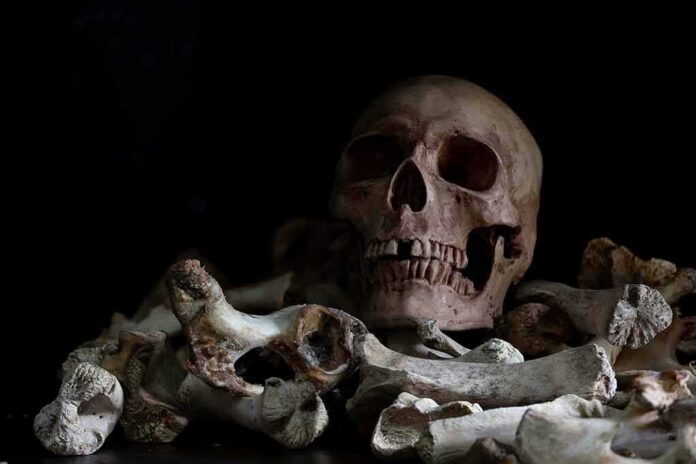
Fresh forensic scans of 5,000-year-old skulls from Egypt’s first kings’ cemeteries point to lethal blows that revive the case for human sacrifice.
Story Snapshot
- Modern analysis found serious head trauma in 18 of 46 skulls from royal-adjacent graves.
- Injuries match blows, chops, and a penetrating wound, not random breakage.
- The graves sit beside First Dynasty rulers’ tombs at Abydos, Egypt.
- Scholars still debate whether all those buried were sacrificed or some died naturally.
What The New Study Found In Ancient Skulls
Bioarchaeologist Roselyn Campbell reexamined 46 skulls tied to subsidiary graves around early royal tombs at Abydos. She reported clear trauma in 18 crania, about thirty-nine percent of the sample. The injuries include long fractures, a chop near an eye, and a puncture on the side of a head. These patterns match violent blows and likely fatal wounds rather than random wear or later damage. The findings raise the odds that some people were killed near the time of burial.
The skulls come from graves grouped around the tombs of First Dynasty figures, such as Djer, Djet, and Meretneith. Early excavators saw hundreds of these graves and suspected retainer sacrifice, where attendants die to serve a ruler in the afterlife. The practice seems limited to this early period and fades by the Second Dynasty. That time box suggests a specific royal custom, not routine violence in a town cemetery. The new trauma data adds physical support to that view.
Why Context Matters For Interpreting Violence
Abydos royal complexes include tight rings or rows of smaller graves that appear planned. Some groups seem to have been closed in a short window, which fits organized death and burial. That plan differs from slow, individual burials over many years. When trauma appears in a large share of those skulls, the pattern points toward deliberate killing. The context and the wounds together make the case stronger than either alone, while still short of full proof.
Even with these results, limits remain. Not every skull shows trauma. People without head injuries could have died naturally or by methods that leave no bone marks, like asphyxiation or poison. The sample also reflects what survived and was saved a century ago, not a full census of all graves. Those gaps mean researchers cannot state that all attendants were sacrificed, or that one single method was used in every case.
What Skeptics Argue And What We Can Say Now
Some archaeologists still propose a different story. They argue that attendants may have died at different times and were later buried near their king. They note earlier reports that found little trauma on the remains. They also point to signs that some graves were sealed in smaller sets, not in one mass event. The new trauma results challenge that view but do not erase it, since many skulls lack clear lethal marks.
For the public, the word “sacrifice” grabs attention and can flood the zone. But the careful read is this: a large minority of tested skulls show likely fatal head wounds, in a sacred zone, beside a new state’s first rulers. That pattern supports retainer sacrifice as a real, if brief, early institution. It also shows how power often writes rules for life and death, then buries the proof. Strong societies face their records, even when those records unsettle us.
Why This Ancient Story Resonates Today
Archaeology here uncovers a hard truth about elite power and human cost. New tools expose what old records did not: people close to the throne may have paid with their lives. Many Americans across left and right fear that elites still bend systems to serve themselves. This study does not judge today’s leaders. It does remind us that when power goes unchecked, regular people bear the risk. Transparency, open data, and outside review help prevent that drift.
What Comes Next In The Research
Researchers say the next steps include sharing full scans and fracture maps, testing for tool marks, and checking whether injuries cluster by tomb, age, or sex. They also want to connect human remains to labels and artifacts to learn who these people were. Those steps can show whether a single method or weapon was used and how closely these dead were tied to the court. Better data will tighten the link between violent death and a royal order, or reveal a mix of causes.
Sources:
smithsonianmag.com, dailynewsegypt.com
© unitedfrontnews.com 2026. All rights reserved.