
As violent crime surges on public transit, a horrifying attack in Chicago’s Loop exposes the real dangers everyday Americans face—and raises urgent questions about whether leftist policies have left our cities lawless and our citizens vulnerable.
Story Snapshot
- A 26-year-old woman was set on fire by a stranger aboard a CTA Blue Line train in downtown Chicago, suffering critical injuries.
- The attack highlights rising violent crime on public transit and the failure of prior leadership to ensure public safety.
- Police launched an arson investigation, with a person of interest in custody as of November 19, 2025.
- The incident has triggered calls for stronger security, accountability, and a renewed focus on law and order.
Violent Crime on Transit Reaches a Shocking New Level
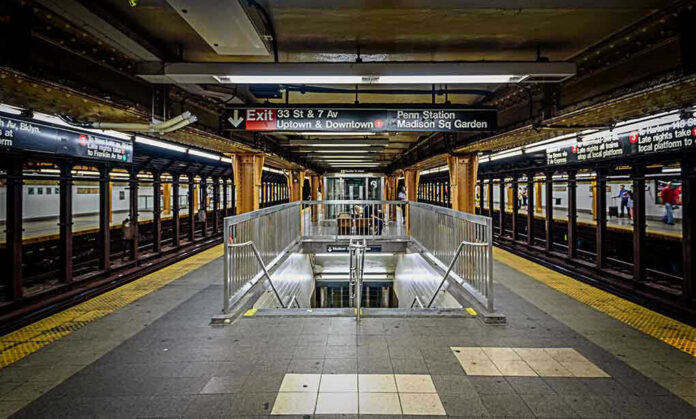
On November 17, 2025, a Chicago Transit Authority (CTA) Blue Line train became the scene of a nightmarish attack when a 26-year-old woman was doused with an unknown liquid and set ablaze following a verbal altercation with a male passenger. The incident unfolded at the Clark and Lake station in the heart of Chicago’s Loop, a central hub for commuters and tourists alike. This brazen act of violence, where fire was used as a weapon, is virtually unheard of on U.S. public transit, underscoring the escalating danger faced by law-abiding Americans in urban centers.
The brutality of the attack shocked witnesses, who rushed to extinguish the flames and assist the victim as she collapsed on the platform. Emergency responders arrived within minutes, transporting her to Stroger Hospital, where she remains in critical condition. The assailant, described as a man in his forties, fled the scene, prompting an immediate manhunt and raising alarms about the effectiveness of transit security in high-traffic zones. Community members and activists quickly offered a $10,000 reward, demanding answers and swift justice for the victim.
Systemic Failures: How Did We Get Here?
This incident did not occur in a vacuum. Chicago’s public transit system has faced persistent issues with violent crime, homelessness, and mental health crises—problems that, many argue, were neglected or made worse under progressive city leadership. Despite repeated calls for stricter enforcement and more visible security measures, previous administrations prioritized so-called “woke” policies and social experiments over the basic need for public safety. Riders have long complained about inadequate policing and a sense of lawlessness, with this attack representing a tipping point for public frustration.
Prior cases of violence on the CTA have typically involved knives or physical altercations, but rarely have such brutal and traumatic weapons been used. The fact that this horrific crime occurred in the evening hours on one of Chicago’s busiest lines is a stark reminder that, for too long, dangerous individuals have felt emboldened to act with impunity while everyday Americans pay the price. The failure to address root causes—while protecting the rights of law-abiding citizens—has left the most vulnerable at risk.
Accountability, Security, and the Demand for Change
In the aftermath, the Chicago Police Department has launched a full-scale arson investigation, and CTA officials claim they are working closely with law enforcement to review surveillance footage and improve response protocols. Federal terrorism charges are reportedly under consideration, reflecting the gravity with which authorities are treating the case. Blue Line service was temporarily suspended but has since resumed, with increased police presence and heightened anxiety among riders. While a person of interest is in custody, the suspect’s identity and motive remain undisclosed, fueling community tension and demands for transparency.
This case has ignited renewed calls for stronger law enforcement, restoration of order, and a rejection of failed “soft-on-crime” approaches. Security professionals are advocating for armed guards and enhanced surveillance, while some community voices stress the need for mental health interventions. The debate over the right balance between safety and civil liberties continues, but the overwhelming consensus among affected Chicagoans is clear: enough is enough. Public safety must come first, and government must fulfill its fundamental duty to protect citizens, not pander to radical agendas that have proven disastrous in America’s cities.
Broader Implications for Urban America
The implications of this attack reach far beyond Chicago. Transit riders across the nation are watching closely, worried that similar failures could put their own communities at risk. Economic consequences are looming, as fear may drive down ridership and increase costs for security measures. Socially, anxiety and frustration are mounting, especially among those who feel abandoned by policymakers more interested in ideology than results. Politically, the pressure is now on city and transit officials to deliver real reforms—restoring the rule of law, upholding constitutional protections, and ensuring that horrific crimes like this do not become the new normal in American life.
Sources:
Woman set on fire during argument on Chicago train, police say
Man allegedly set woman on fire on Chicago train