

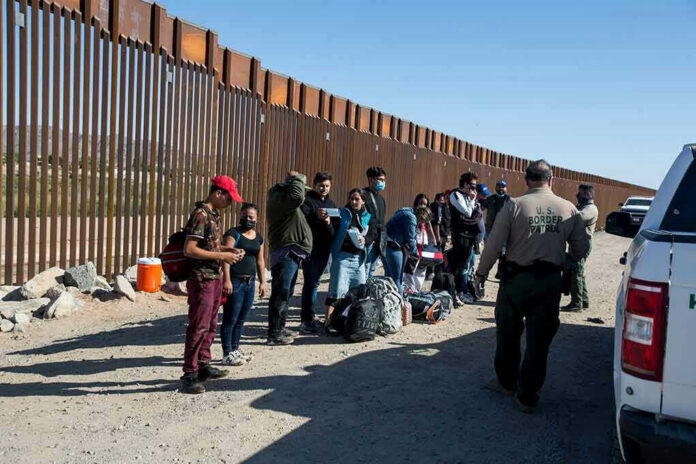
Cartels are gaming U.S. border processing with fake families and “ghost” identities while child-protection safeguards were dismantled, according to detailed testimony from a former Border Patrol agent.
Story Highlights
- Former agent Ammon Blair describes cartels fabricating identities and addresses that slip through cursory checks [1].
- Claims that rapid DNA testing ended, weakening verification of adult–child relationships and aiding traffickers [5].
- Testimony outlines fake family units exploiting catch-and-release policies due to limited verification capacity [3].
- Blair says cartels coerce indebted migrants, spreading influence across all 50 states [1].
How Cartels Exploit Identity Gaps at First Contact
Ammon Blair, a former United States Border Patrol agent and current Texas Public Policy Foundation fellow, says cartels craft “ghost” identities for migrants using fabricated identification and addresses that often receive only a basic postal website check by processing agents [1]. Blair explains that smugglers coach arrivals to present credible addresses, which can pass a simple validation of existence rather than a person-to-residence match. This minimal verification, he argues, allows organized networks to seed untraceable identities into the interior.
Blair’s account describes a system strained by record encounters, where agents prioritize triage and release decisions over deep-dive authentication [1]. He says the cartels understand these operational limits and have built a productized pipeline around them. According to Blair, the result is a high-volume intake process that confirms addresses exist but rarely confirms a verifiable link between the migrant and the claimed residence, enabling fraud that becomes harder to unwind once people move beyond initial custody.
Fake Family Units and the End of Rapid DNA Checks
Blair testifies that cartels manufacture family units by pairing unrelated adults and children to exploit more lenient treatment for families compared with single adults [3]. He cites past federal processing practices that struggled to quickly verify claimed relationships, creating an incentive for smugglers to attach minors to adults to speed release. Blair argues that this tactic flourished when verification tools were thin and processing backlogs large, giving cartels a clear playbook to convert fraudulent claims into lawful presence pending hearings.
Blair further asserts that the federal government discontinued rapid DNA testing, a tool designed to assess biological relationships between adults and minors in custody [5]. He calls the program’s removal a direct blow to child safety that forced agents to rely on self-reported relationships, increasing the risk that trafficked children would be released with unrelated adults. Blair cites this as one of the most effective safeguards ever deployed against cartel-driven child exploitation, and says its dismantling emboldened traffickers by lowering the chance of immediate exposure [5].
Debt-Bonded Migrants and Nationwide Reach
Blair contends that migrants who cross with cartel facilitation are often indebted to smuggling organizations, creating leverage that can persist after release into the United States [1]. He describes this debt as a coercive tool the cartels use to compel work, silence, or continued criminal cooperation, extending influence beyond border regions. Blair says these networks now touch all 50 states as migrants disperse, with obligations following them into urban and rural communities through cartel-directed contacts and assignments [1][2].
Blair also describes Mexican cartels as sophisticated transnational enterprises operating across land, maritime, air, and cyber domains, not merely drug-trafficking gangs [4]. He presents them as foreign organizations capable of rapidly adapting to U.S. policy signals and logistical choke points. This framing underscores his central warning: when federal verification tools and procedures are weakened, cartels quickly retool smuggling packages to exploit the gap, moving people, drugs, and money through channels optimized against the thinnest checks [4].
What Is Strongly Supported—and What Remains Unproven
Blair provides firsthand detail on minimal address verification, fake family unit tactics, and the operational value of rapid DNA testing for child protection [1][3][5]. His testimony aligns with long-running concerns about catch-and-release incentives when verification capacity is limited. However, he offers no direct documentary proof of a formal mandate to “look the other way,” and supplies no specific examples of named terrorists released due to these gaps, leaving those particular claims uncorroborated in the record he presents [1][3][5].
Critics label Blair partisan, pointing to his affiliation with a conservative policy group and the predominance of right-leaning platforms carrying his message [5]. That critique does not, by itself, rebut his operational descriptions. For readers demanding accountability, the most practical next steps are document-driven: request Customs and Border Protection policies on family verification after the end of rapid DNA testing, seek release outcome data for family units, and obtain corroborating agent testimonies regarding address checks and identity vetting protocols [5].
Why This Matters to Public Safety and the Rule of Law
Border policy that fails to verify identity and family claims invites abuse that endangers children, burdens communities, and rewards criminal syndicates. Blair’s testimony urges a return to tools that protect minors, investments in real vetting tied to person-to-residence verification, and consequences that deter fraud [1][5]. For a nation built on lawful immigration and secure borders, allowing cartels to dictate the terms of entry is unacceptable. Congress and the administration should close these gaps swiftly, transparently, and decisively.
Sources:
[1] YouTube – A Former Border Patrol Agent Explains | The Brief
[2] Web – “They’re Slaves to the Cartels”: Inside the Border Pipeline | PragerU
[3] YouTube – TPPF’s Ammon Blair Testifies in Support of HB 256 in House State …
[4] Web – TPPF’s Ammon Blair Testifies on SB 36 in the Senate Border …
[5] Web – [PDF] Ammon Blair Testimony on HB 256 – Texas Public Policy Foundation