
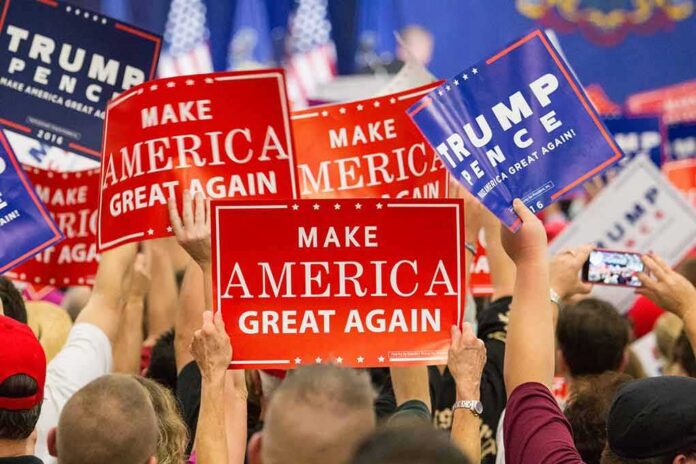
Despite pounding rain and delays, President Trump’s Oklahoma rally drew a loud, loyal crowd that turned weather into a show of strength.
Story Snapshot
- Hundreds lined up for hours in the rain before the rally doors opened.
- Trump used the Durant stop to boost Republican candidates and policy themes.
- Weather delays pushed Trump’s remarks later than planned, but the event continued.
- Protesters gathered nearby in smaller numbers during the rally.
Supporters Brave Rain for Early Entry
Local outlets reported that hundreds of supporters arrived early and waited in steady rain outside the Choctaw Event Center in Durant on October 1. People stood in lines for hours to secure seats before President Trump spoke. Reporters on scene described “numerous supporters” who stayed despite the weather and kept spirits up as they waited for doors to open. That visible patience and turnout became the first headline of the event day for both national and local coverage.
The rally marked Trump’s first Oklahoma appearance since 2020, adding to the draw for in-state and nearby supporters. The site choice also mattered. The Choctaw Event Center offered indoor space with capacity reported near seven thousand, which gave organizers room to manage weather and security concerns. Free tickets were available through the Republican Party’s online portal, a common approach that aims for speed, scale, and data capture before big political events.
Message: Energize Voters and Lift Allies
Trump used the Durant stop to amplify Republican candidates and party priorities ahead of the midterms. State and national Republicans framed the event as part of a short tour through strong conservative regions to lock in turnout and enthusiasm. Coverage noted repeated appeals for voters to back Trump-endorsed contenders and to lean into themes like energy production and local industry. That mix speaks to a base-first strategy in a deep-red state as early voting nears.
Trump also tailored remarks to local pride and identity. During his speech, he praised Oklahoma and said he had even thought about moving there, a line that drew loud cheers and nods to shared values. Local media highlighted those comments alongside policy notes, linking the personal touch with the push for down-ballot support. The personalization is a common rally tool to make national messages feel rooted in place and culture for the audience.
Weather Delays, Then a Full Program
Storms and travel issues delayed the start of Trump’s remarks. National coverage reported that he began speaking nearly two hours later than scheduled. Even so, the program proceeded with standard rally beats once it got underway. The delay did not flip the narrative on attendance or mood. Instead, the crowd’s willingness to wait helped Republicans showcase momentum and loyalty in a news cycle that prizes quick visual proof of strength and staying power.
President Trump Speaks at Durant Rally, Highlights Oklahoma Energy, Family Farms and Economy https://t.co/UArLOPYYJF pic.twitter.com/yPX00QVlAh
— Ron Hays (@Ron_on_RON) October 2, 2026
Outside the venue, a smaller protest took shape near a nearby intersection. Local reporting described dozens of demonstrators holding signs and voicing opposition to Trump’s policies. Police presence managed traffic and safety, and there were no major incidents reported in that coverage. The split screen—large pro-Trump crowd inside, smaller protest outside—is now a standard feature of modern rallies across the map, especially in high-salience stops.
Why Rally Optics Still Matter
Campaign-style rallies are political theater and organizing engines. Visible enthusiasm becomes social proof, which can lift fundraising, volunteer sign-ups, and earned media reach. The Durant event fit that model. Republicans got images of long lines, loud chants, and a familiar message ladder. Those images help shore up a core belief shared by many frustrated voters on both sides: leaders should show up, speak plainly, and face the public, even when the weather is rough or plans slip.
For conservatives, the message aligned with energy security, border control, and cost-of-living themes. For liberals, the protest signaled enduring pushback on policy, inequality, and treatment of minority groups. Yet beyond those divides, the day reflected a wider frustration with a federal system many see as slow, distant, and guided by insiders. The rally’s biggest signal was durability: people showed up, waited, and engaged, insisting that their voices still count in a noisy, crowded system.
What to Watch Next
Republicans will try to convert that energy into turnout and local organizing in the final stretch. Watch for follow-up visits, targeted ads around energy and agriculture, and more down-ballot endorsements tied to Trump’s brand. Democrats will answer with emphasis on economic fairness and rights, and will likely feature scenes from smaller but steady protests. The next test is simple: which side turns rally moments into votes and policy leverage when ballots are cast.
Sources:
facebook.com, oklahoman.com, koco.com, kosu.org, yahoo.com, nbcnews.com
© unitedfrontnews.com 2026. All rights reserved.