

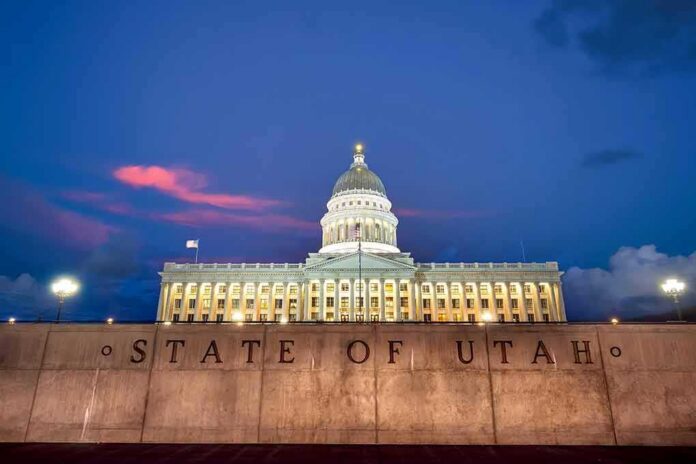
Hundreds of thousands of dollars from a coordinated progressive donor network helped flip 18 Republican-held Utah legislative seats, cracking a decades-long red stronghold.
Story Snapshot
- Deseret News traced a web of nonprofits and PACs that backed most flipped seats.
- Utah Investment Network, a related PAC, gave at least $140,800 directly to candidates.
- Funds flowed through national groups, including the Sixteen Thirty Fund, which received major support from Open Society Action Fund.
- Governor Spencer Cox said redistricting and voter frustration also drove losses, not just money.
What Happened In Utah’s Legislative Shake-Up
Deseret News reported that a network tied to the Utah Donor Collaborative played a major role in nearly all of the 18 legislative races where Republicans lost seats. The report described hundreds of thousands of dollars moving through allied groups that boosted targeted candidates and helped reshape the State Capitol’s balance of power. The paper said the shift was part of a broader “blue wave,” yet it tied donor activity to most of the changed districts during the last election cycle.
State records and reporting identified the Utah Investment Network as the collaborative’s political arm. That committee gave at least $140,800 straight to candidates across the state, creating a direct link between the donor hub and individual campaigns. Candidate-level examples showed layered support. One cited winner received money from the collaborative, a local stewardship group, and a separate political committee, showing how direct donations and outside aid mixed in single races.
How The Money Moved Through Nonprofits And PACs
The funding web included Western Conservation Action, Western Futures Fund, and Way Back PAC, which shared ties and, in some cases, a common Wyoming address, according to the reporting. The Sixteen Thirty Fund, part of a national progressive nonprofit network, also appeared in the chain that reached Utah. Deseret News noted the Open Society Action Fund, founded by George Soros, gave at least $68 million to the Sixteen Thirty Fund in recent years, establishing an indirect national-to-state link.
Political scientists have documented how nonprofit networks route money and services outside formal party lines. Research shows these networks can act like “shadow” party structures, sending funds and personnel from central hubs to local election groups while limiting donor visibility. This pattern matches the Utah reporting’s mix of direct contributions, pass-through grants, and supportive outside groups that amplified candidate efforts in competitive districts.
Why Voters Flipped — Money, Maps, And Mood
Governor Spencer Cox said many Utahns felt ignored during redistricting and after lawmakers changed Proposition 4. He called those actions major factors behind Republican losses, suggesting voter backlash, not just outside money, shaped the map and the mood. Education and migration trends also played a role. Analysts have tracked college-educated voters moving left, plus in-migration of liberal, non-Mormon residents, which together have narrowed gaps in parts of the state.
“Why the Red West Must Be Won": That was the title of a panel discussion at the Utah Donor Collaborative's annual member meeting last year.
In 2026, the UDC proved its mission — to replicate the political transformation in Colorado, starting with the state Legislature — can…
— Brigham Tomco (@BrighamTomco) November 18, 2026
Redistricting scrambled many races. Ballotpedia reported that 49 of 68 incumbents seeking reelection in 2022 ran in new districts, changing who they faced and which voters decided their fate. Some internal party shifts also mattered, as moderate Republicans lost to more conservative challengers in certain primaries, reshaping the field before the general election. These factors complicate efforts to credit any single cause for all 18 seat flips.
What This Says About Power, Transparency, And Trust
Utah’s case shows how national money meets local politics. The donor network did not “cause” every outcome on its own, but it touched most flipped seats and gave challengers tools to compete. That matters to voters across the spectrum who worry elites steer elections from the shadows. At the same time, the governor’s comments and the data on redistricting and voter shifts show how policy choices and map changes can spark backlash, even in deep-red states.
What To Watch Next In Utah
Watch for clearer filings that map each race’s funding sources against vote margins. A race-by-race ledger would test how much donor money moved the needle versus district changes or voter realignment. Also watch whether lawmakers tighten disclosure rules for nonprofits and pass-throughs. Courts have recently favored speech and coordination rights, but scholars still argue disclosure helps citizens follow the money without chilling participation. Utah’s trust problem will not fade without more daylight.
Sources:
deseret.com, yahoo.com, cityweekly.net, utahpolitics.news, axios.com, cambridge.org
© unitedfrontnews.com 2026. All rights reserved.