

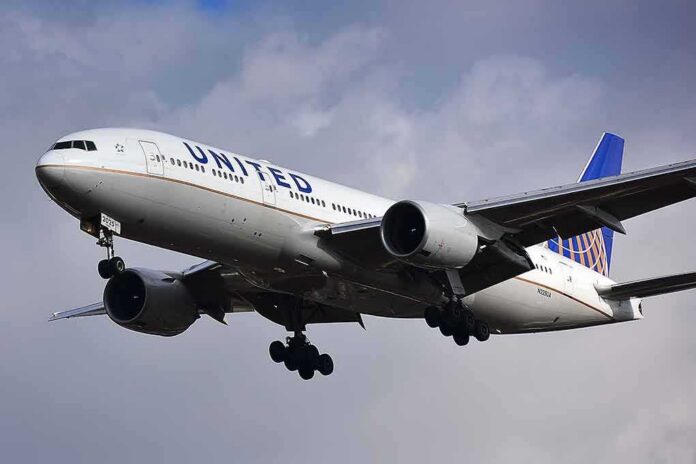
A United Airlines flight sent a hijack alert after a passenger said he had a bomb and tried to reach the cockpit, but the plane landed safely and the suspect was arrested.
Story Snapshot
- United Flight 2174 reported a bomb threat midair and a passenger tried to approach the cockpit.
- The plane landed safely in New Orleans; deputies arrested the suspect without incident.
- Officials booked the man on felony counts tied to false threats and terrorizing.
- The incident comes as airlines face more unruly passengers and repeated hoax bomb alerts.
What Happened Onboard United Flight 2174
United Flight 2174 from Newark to New Orleans sent a hijacking alert Monday night after a passenger claimed he had a bomb and moved toward the cockpit. Jefferson Parish deputies said the man began acting irrationally around 11:20 p.m. and told crew he had an explosive device. Pilots and crew followed safety procedures and continued to New Orleans. The aircraft landed safely, and law enforcement met the plane at the gate to take the suspect into custody.
Authorities identified the passenger as 34-year-old Rony Alexander Gomez-Alberto in multiple reports. The Jefferson Parish Sheriff’s Office said deputies arrested him without incident after landing and booked him on charges for communicating false information of planned arson and for terrorizing. United Airlines said the crew handled the situation according to training. No explosive device was found, and officials described the threat as a false report after the plane was secured.
How Officials Respond To Bomb Threats In The Air
Airport police and airline crews treat bomb threats as real until they are checked, even though most prove false. Reuters reported that the vast majority of bomb threats to planes turn out to be false alarms, yet every one must be handled as credible until investigated to keep people safe. Recent reports from Europe showed waves of hoax threats that forced diversions, searches, and even fighter escorts, with no explosives found on the planes.
These events raise costs, strain staff, and unsettle passengers. But experts warn that downplaying a threat can be worse if one is real. Airlines follow set steps: isolate the person, alert pilots, secure the cockpit, and coordinate with police on landing. This measured response is meant to avoid panic while keeping control. Monday night’s United flight followed this playbook and ended without injuries or damage, which is the goal of the system.
Unruly Passenger Trend And Flight Deck Security
The Federal Aviation Administration (FAA) recorded 2,102 unruly passenger incidents in 2024, showing that crews face more midair disruptions. Security planners also track higher-level threats, which include attempts to reach the cockpit. Over the past decade, officials counted more than 150 level three threats and more than 40 level four threats, the most severe category. These numbers help explain why airlines keep strict rules for cockpit access and rapid response.
Researchers have long warned that the flight deck is most vulnerable when the door opens for brief moments. Training and new barriers aim to reduce that risk window. The suspected approach toward the cockpit on Flight 2174 again highlights that gap. Crews now rely on reinforced doors, secondary barriers on some aircraft, and procedures that time door openings with protective steps. These layers try to slow a threat long enough for help or landing.
Why This Resonates Across The Political Spectrum
People on the right and left worry that basic safety is slipping, while government systems feel slow and reactive. This case touches many shared concerns: border enforcement, court decisions, airline safety, and the cost of repeated hoax threats. The flight landed safely, which shows training works. But the incident adds to pressure on leaders to keep dangerous people off planes, speed up security checks, and hold offenders accountable without overburdening travelers and crews.
United Airlines Passenger Claims to Have Bomb, Attempts to Enter Cockpit
A passenger aboard a United Airlines flight from Newark to New Orleans reportedly attempted to enter the cockpit while claiming to be carrying a bomb. A hijacking alert was issued following the incident,… pic.twitter.com/kPfdNqRSXa
— AirwayBuzz (@AirwayBuzz) November 11, 2026
Most bomb threats are false, but each one disrupts lives and drains resources. Clear rules, fast coordination, and firm penalties can deter hoaxes while keeping the public safe. Passengers also have a role: report issues early and follow crew instructions. The system worked Monday night because people did their jobs. Many Americans, across party lines, want that same level of focus from leaders before, not only after, a scare.
Sources:
en.royanews.tv, timesnownews.com, dailymail.com, kpel965.com, faa.gov
© unitedfrontnews.com 2026. All rights reserved.